
Roof Life Oregon: What Really Determines Its Duration
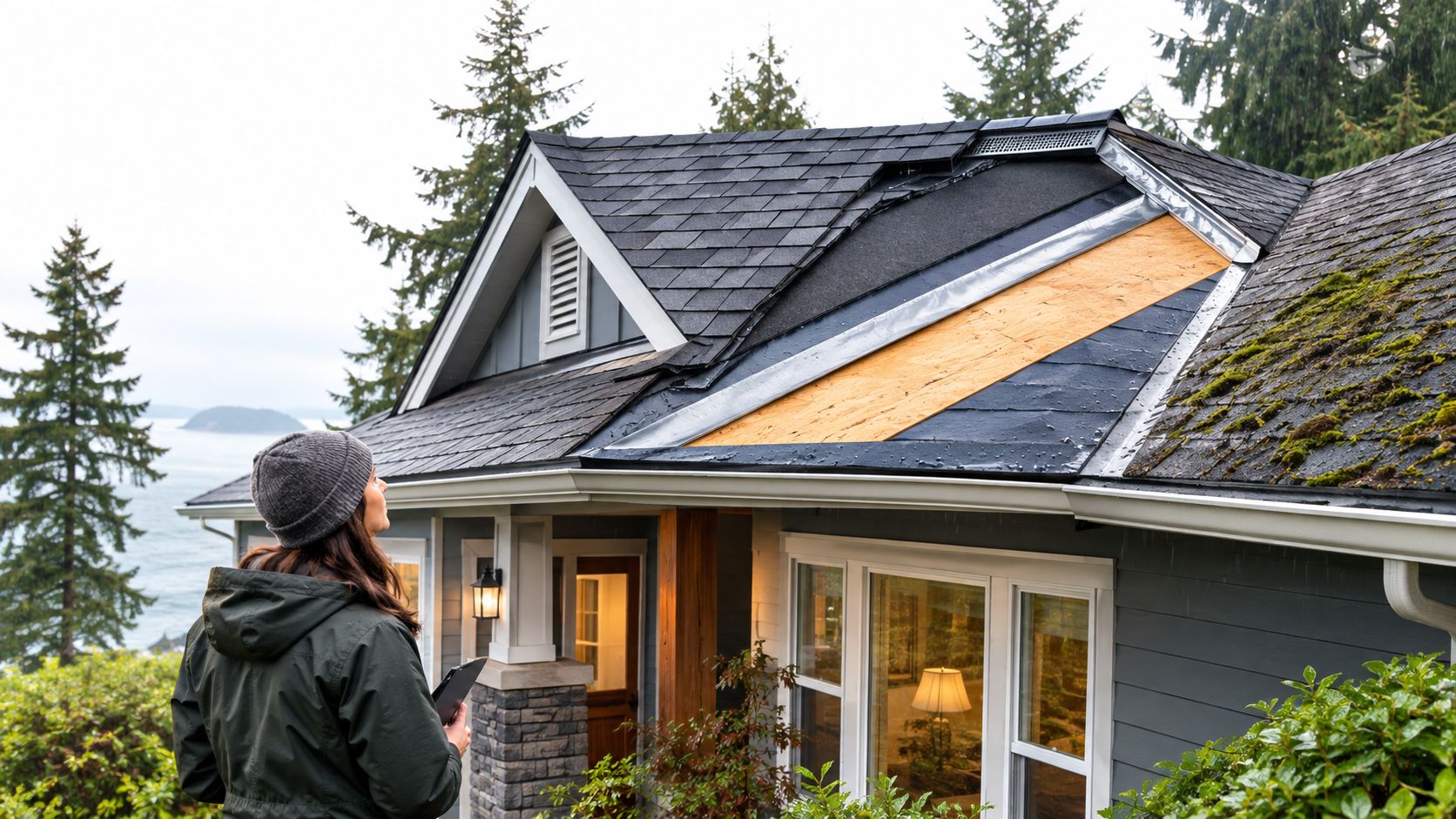
You're looking out at the roof after another rainy morning in the Willamette Valley. The shingles still look reasonably straight, but there's moss along an edge and a ceiling stain you don't remember seeing before. You're trying to answer a practical question: does this roof need attention now, or does it still have useful life left?
Table of Contents
- Why a Western Oregon Roof Can Fail Long Before Its Warranty Ends
- How the Pacific Northwest Climate Actually Shortens Roof Life
- The Roof Assembly You Never See and Why It Sets Roof Life
- Matching Materials to Oregon Conditions Rather Than to a Warranty Chart
- Warning Signs You Can Check from the Ground or a Ladder
- Repair Now or Replace Next Year, A Decision Guide
- Licensing, Permits, and the Best Seasons for Roof Work in Oregon
- What to Do Next if Your Roof Is Telling You Something
Why a Western Oregon Roof Can Fail Long Before Its Warranty Ends
Consider a typical homeowner situation in Salem or Keizer. From the driveway, the roof looks presentable. There aren't obvious bare patches, and the original paperwork describes a long manufacturer's warranty. During steady rain, though, water appears near a wall.
That's an illustrative situation, not a customer case study. It shows why shingle age alone is a poor replacement trigger. The visible covering can look acceptable while a flashing connection or the wood underneath needs repair.
A manufacturer's nominal lifespan isn't a promise about a particular Oregon home. A useful assessment considers the deck, flashing, ventilation, insulation, and moisture conditions, rather than relying only on visible granule loss, as reflected in Oregon's residential building-energy framework.
Start with the problem, not the label
When someone asks how much longer a roof will last, the useful response starts with questions. Where is water getting in? Is the problem isolated? Can the surrounding materials support a lasting repair?
Those questions separate a repairable detail from a roof that needs broader work. They also keep a homeowner from replacing sound roofing merely because it looks weathered.
Practical rule: Judge remaining roof life by what's failing and what can be corrected, not by the biggest number on the shingle paperwork.
For homeowners researching roof life in Oregon, the important distinction is between the roof covering and the roof assembly. You buy shingles or metal panels, but you depend on the whole assembly to keep the house dry. An estimate that discusses only the surface leaves too much unanswered.
How the Pacific Northwest Climate Actually Shortens Roof Life
Western Oregon roof work starts with a simple question: where does water go, and where does it stay? Long wet seasons, stretches of constant rain, and persistent dampness make that question relevant in Salem, the Portland metro, and the central coast.
The main exposure patterns are summarized below.
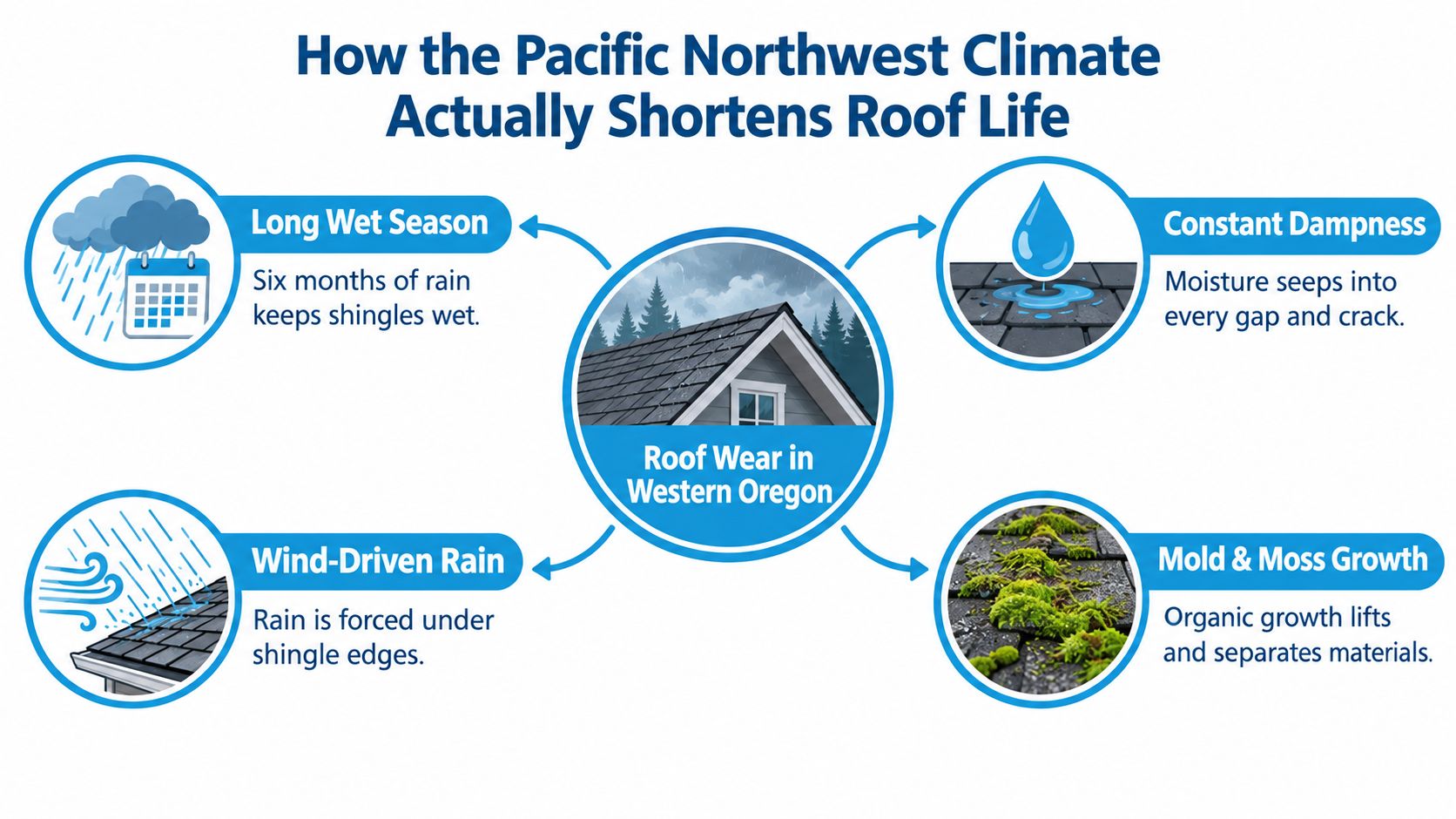
Think of roof inspection as following water through a series of handoffs. Rain reaches the covering, moves toward valleys and edges, and should leave through the drainage system. Wind-driven rain deserves separate attention because it can reach beneath the primary covering at vulnerable details.
Dampness and growth need different responses
Oregon State University describes moss as a low-growing plant that thrives in wet conditions. That makes persistent growth a reason to examine moisture conditions, not just schedule the most aggressive cleaning available.
Dark algae staining and thick moss shouldn't automatically receive the same diagnosis. Ask whether the proposed moss removal and roof cleaning will remove existing growth, slow regrowth, or address materials already damaged underneath it. A cleaner-looking roof isn't proof that the underlying condition has improved.
- Inland exposure: In the mid-Willamette Valley and Portland's shaded neighborhoods, ask the inspector to compare persistently damp areas with more open roof surfaces.
- Coast Range wind storms: After strong winds, request attention to edges, transitions, and any visibly displaced roofing.
- Coastal salt air: In Lincoln City and Newport, ask whether the proposed metal components and fastening details are appropriate for the property's exposure.
These are inspection priorities, not reasons to assume every coastal roof needs replacing. A sheltered inland house and an exposed coastal house shouldn't receive interchangeable recommendations.
For a visual companion to the wet-weather discussion, watch the following video.
The Roof Assembly You Never See and Why It Sets Roof Life
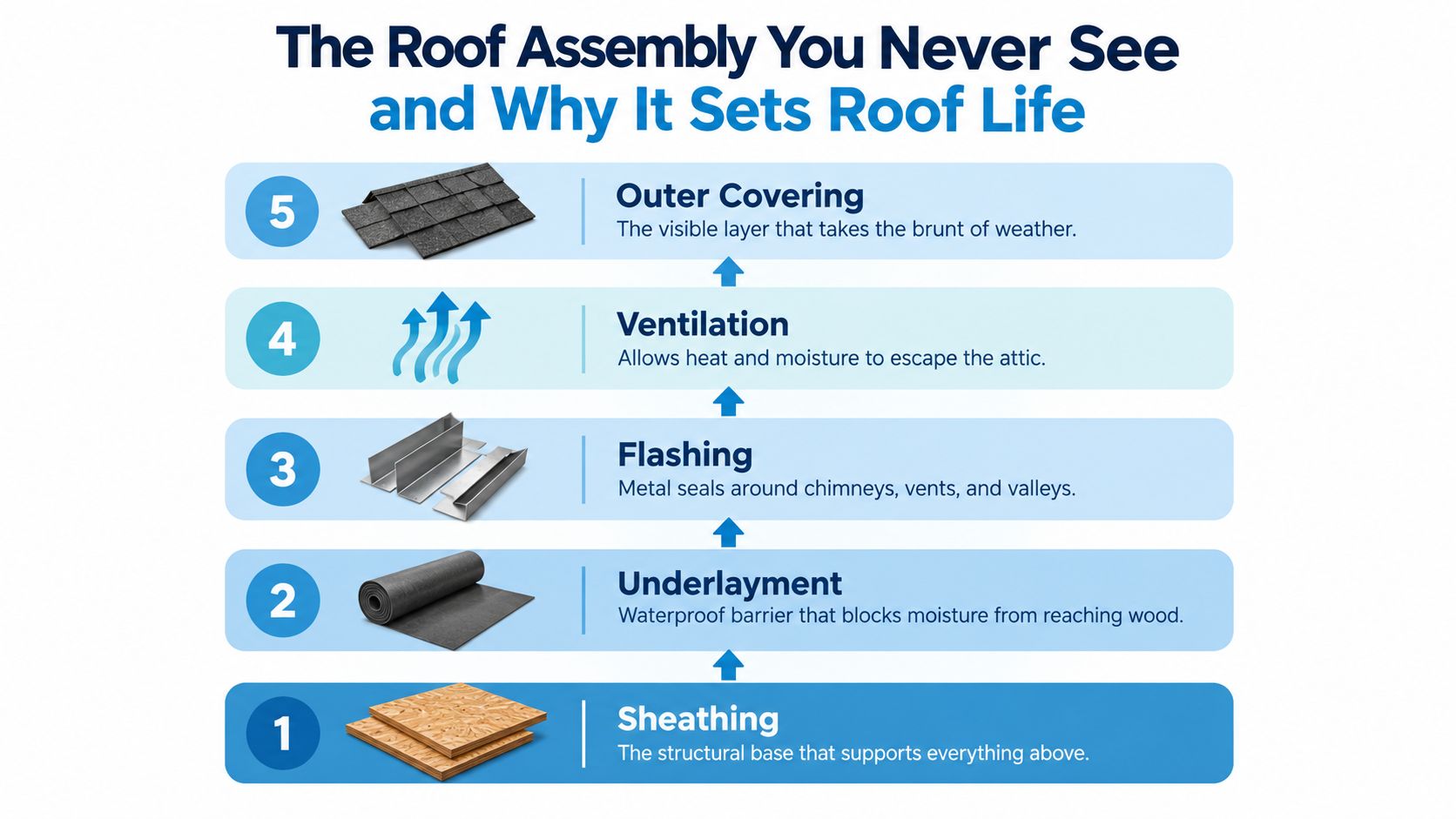
A roof inspection should explain how the components work together, including what the inspector couldn't see without opening the roof. Hidden conditions should be identified as unknowns, not treated as sound by default.
This diagram identifies the main components to discuss with your roofer.
What belongs in the inspection
The deck or sheathing supports the roof materials. The underlayment provides secondary water protection, while flashing directs water through vulnerable intersections. The outer covering takes the direct weather exposure.
The Oregon roof-assembly code provisions require underlayment beneath asphalt shingles, metal panels, and other common coverings, with installation governed by manufacturer instructions. They also require ventilation compliance during reroofing when sheathing is replaced.
Valleys deserve particular attention because different roof planes meet there. If you're considering metal, understanding valley details for metal roofing helps you ask about the actual water-management detail rather than just the panel color.
Ventilation needs a complete pathway
Attic ventilation isn't a matter of adding a ridge vent. Low intake and high exhaust need to work together, without insulation blocking the intake openings.
Portland's residential roof-ventilation guidance specifies a baseline net free ventilation area of 1/150, with 1/300 permitted only under stated conditions, including a Class I or II warm-side vapor retarder. The same guidance places 40–50% of the required area high in the roof, within 3 feet of the ridge, with the remainder in the lower third.
Ask the roofer to document intake obstructions, exhaust continuity, bathroom-exhaust termination, condensation, and deck-edge deterioration. Those observations are more useful than an estimate that merely says “ventilation included.”
A new covering over compromised wood or unresolved moisture problems can improve the appearance without correcting the cause of early failure.
Matching Materials to Oregon Conditions Rather Than to a Warranty Chart
Architectural asphalt shingles, metal roofing, and TPO belong in different conversations. The right choice depends on the roof's shape, exposure, existing construction, and the maintenance you're prepared to arrange.
Start with suitability, then compare appearance and price. Ask the contractor to show that the proposed system is appropriate for the actual slope and that its installation details follow the manufacturer's requirements. Don't accept a material recommendation based only on a warranty headline.
Material Performance in Western Oregon Conditions
| Material | Behavior in Wet Oregon Climate | Maintenance Considerations |
|---|---|---|
| Architectural asphalt shingles | Evaluate the complete water-shedding layout, especially shaded areas, edges, and transitions. | Ask how moss will be managed without damaging already worn shingles and how localized repairs will be handled. |
| Standing seam or metal panels | Review panel profile, seams, valleys, and fastening details for the home's rain and wind exposure. | Ask about debris-catching transitions, component compatibility, and inspection needs in coastal salt air. |
| TPO for flat or low-slope sections | Evaluate the membrane as a complete system, including drainage, seams, penetrations, and perimeter details. | Request an inspection plan for seams, terminations, debris, and areas where water remains after rain. |
Choose for the awkward parts of your roof
A porch or low-slope addition may need a different approach from the main roof. Don't insist on matching materials everywhere if doing so leaves a questionable transition or drainage detail.
For asphalt, ask how the roofer plans to handle growth-prone areas and future repair access. For metal, ask where needles could collect and how the proposed profile suits the property. For TPO, focus the discussion on drainage and transitions rather than treating the membrane itself as the whole solution.
There isn't a universal winner. A carefully detailed system suited to the house is a more sensible purchase than an impressive material installed over unresolved problems.
When comparing estimates, keep the scopes consistent. A proposal that includes deck allowances, flashing replacement, and moisture corrections isn't directly comparable to one that prices only the visible covering.
Warning Signs You Can Check from the Ground or a Ladder
Never walk on your roof to inspect it. Use the driveway, yard, or an accessible window, and leave close-up roof work to a professional. You don't need to climb a ladder just because a checklist mentions gutters.
The following signs help you decide what to photograph and discuss with an inspector.
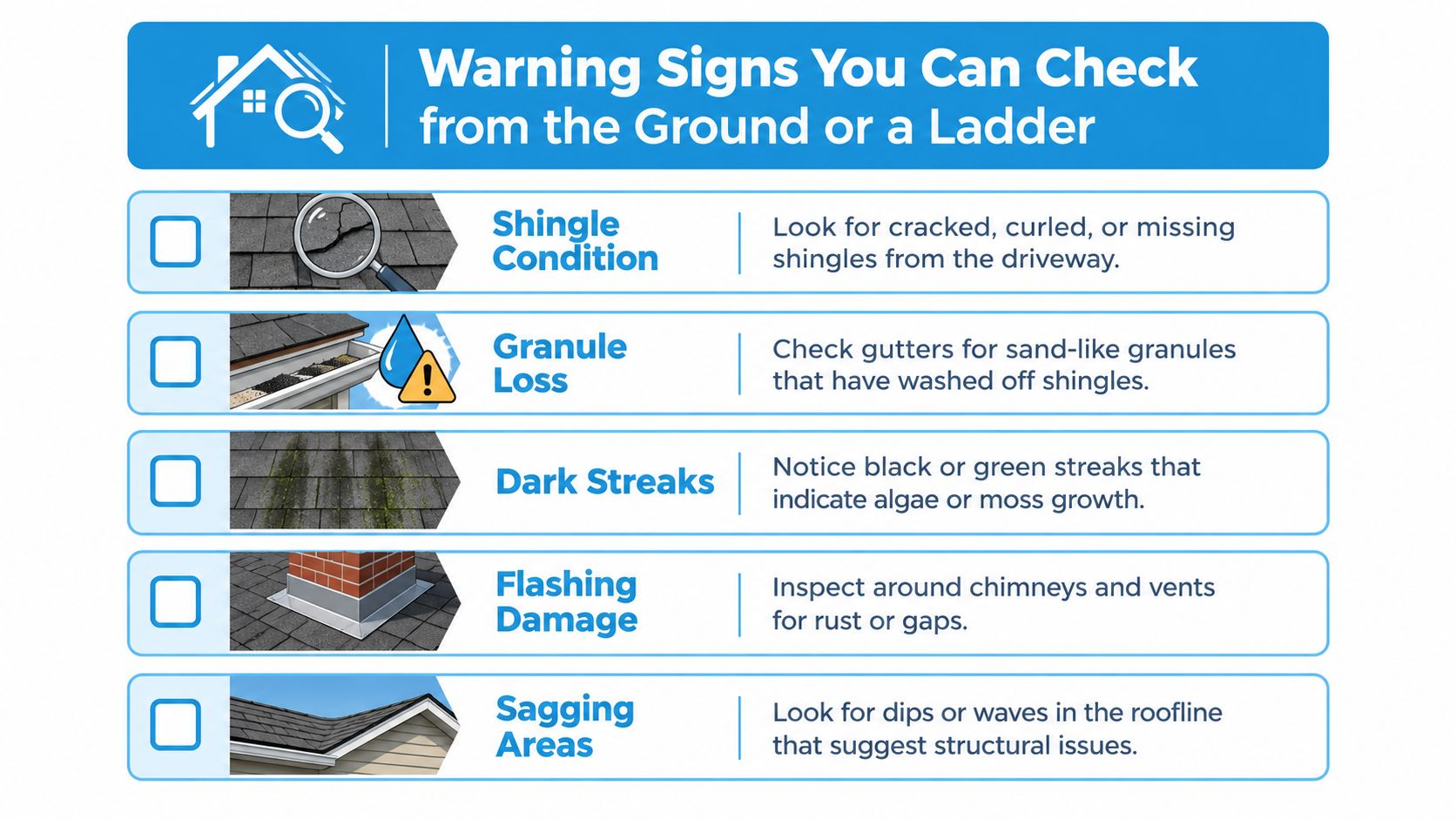
Build a useful record without climbing
Take clear photographs from the same safe locations. Note whether a stain appeared after wind-driven rain, steady rain, or an overflowing gutter. That information helps a roofer investigate rather than guess.
- Shingle condition: Photograph missing, curled, or visibly cracked areas. Don't assume a distant view can establish whether the remaining shingles are brittle.
- Growth patterns: Record concentrated moss, dark streaks, and debris pockets. Appearance alone doesn't establish the extent of damage.
- Gutters and fascia: Look for overflow, staining, and sand-like material at accessible outlets. Ask a professional to inspect gutter contents rather than leaning out from a ladder.
- Interior changes: Note ceiling stains, peeling paint, or damp surfaces, including whether they change during rain.
If the attic is safely accessible, observe from a secure position without stepping onto ceiling materials. Photograph visible moisture, staining, or unexpected daylight, and let the inspector interpret what you've found.
Safety first: A useful homeowner inspection ends where safe access ends.
Active dripping, a newly sagging roofline, or roofing displaced after a storm warrants prompt professional attention. Stable discoloration without active leakage can usually be documented for a scheduled inspection, but it shouldn't be dismissed indefinitely.
Don't disturb a bulging wet ceiling or approach water near electrical fixtures. Keep people away from the affected area while arranging appropriate professional help.
Repair Now or Replace Next Year, A Decision Guide
Repair makes sense when the defect is limited and the surrounding roof can support a durable correction. Replacement becomes more reasonable when the inspection finds widespread deterioration or when fixing isolated symptoms would leave the larger failure unresolved.
For example, an isolated flashing problem on otherwise serviceable roofing deserves a repair discussion. Recurring leakage at the same location deserves a more searching explanation than another surface patch.
Ask for evidence behind the recommendation
A useful roof leak repair assessment should identify the likely entry point, the affected materials, and what the contractor needs to open to confirm the diagnosis. Ask whether the proposed work corrects the cause or provides temporary weather protection.
| Inspection finding | Decision to discuss |
|---|---|
| Isolated defect with sound surrounding materials | A targeted repair with a clearly defined scope |
| Repeated leakage despite previous patches | Further investigation before authorizing another similar repair |
| Soft decking or concealed deterioration | Opening the affected area and pricing the necessary corrective work |
| Widespread shingle brittleness or multiple failing details | Replacement planning rather than scattered patches |
| Ventilation imbalance | A documented correction plan alongside the roofing decision |
| Moss without established material failure | Cleaning and condition assessment before assuming replacement |
Separate urgency from project size
An active leak needs attention, but it doesn't automatically justify replacing the entire roof. Equally, a roof that isn't dripping today may still warrant replacement planning if the contractor documents broad deterioration.
Ask for photographs and a written explanation of what can remain, what must be removed, and what remains uncertain. If you're hoping to defer replacement until next year, request a clear description of the interim repair's limits.
Repeated patching can become false economy when nobody investigates the concealed condition. The opposite mistake is paying for replacement solely because the roof looks green.
Costs can range from a limited repair scope to a full replacement project, but a meaningful dollar range requires property-specific information. Roof size, access, material choice, concealed deck damage, and corrective details all affect price. Request a free written estimate with allowances explained before deciding.
Licensing, Permits, and the Best Seasons for Roof Work in Oregon
Before signing, verify any contractor's active Oregon CCB license. Match the business name on the proposal to the state record rather than relying on an advertisement that says “licensed and bonded.”
Oregon CCB licensing requirements generally apply to contractors paid to improve real property and include bonding and liability insurance requirements. The Oregon license directory also describes ongoing continuing education, renewal obligations, and the Responsible Managing Individual responsible for the required business-practices and law qualification.
Get the local scope determination in writing
Don't assume every reroof requires the same permit, or that calling work a repair settles the question. Ask the building department serving your property whether the proposed scope requires permits, inspections, or additional documentation, particularly when sheathing or structural conditions are involved.
Energy requirements also need careful handling. Oregon's energy-code information distinguishes residential requirements from other building categories. Commercial reroof insulation guidance shouldn't be applied automatically to an ordinary residential shingle replacement.
- Before signing: Request a written determination of applicable requirements and who will obtain permits.
- Before comparing prices: Confirm who pays for required corrections and how concealed conditions will be authorized.
- Before scheduling: Ask how the crew will protect exposed areas if the forecast changes.
Plan around weather windows
As a practical scheduling preference, aim for summer or a settled early-fall window in the Willamette Valley. On the central coast, let the actual wind and rain forecast carry more weight than the calendar.
Drier windows make it easier to coordinate tear-off and installation, but product-specific application and curing requirements still govern. Don't postpone an active leak to reach a preferred season. Ask about repair now and larger work when suitable conditions are available.
What to Do Next if Your Roof Is Telling You Something
Start with what you can safely document: photographs, the location of interior staining, and notes about when the problem appears. Gather previous repair paperwork if you have it, but don't let missing records delay an inspection when water is entering the house.
The useful next step is a condition-based assessment, not a lifespan prediction made from the driveway. Ask the inspector to distinguish confirmed defects from suspected concealed damage and explain which work is urgent.
Compare the proposed work, not just the total
A written estimate should identify materials, removal work, flashing details, deck allowances, and any necessary moisture corrections. It should also explain what happens if opening the roof reveals additional damage.
You don't have to commit to replacement because you request an inspection. A clear scope lets you compare repair with replacement and make a decision suited to your home, your timing, and the evidence.
Safeguard Roofing LLC offers roof inspections, repair, replacement, and moss removal and roof cleaning for homeowners assessing remaining roof life in western Oregon. Visit Safeguard Roofing LLC, call 971-518-0028, or request a free written estimate to discuss your roof's condition without committing to a replacement.