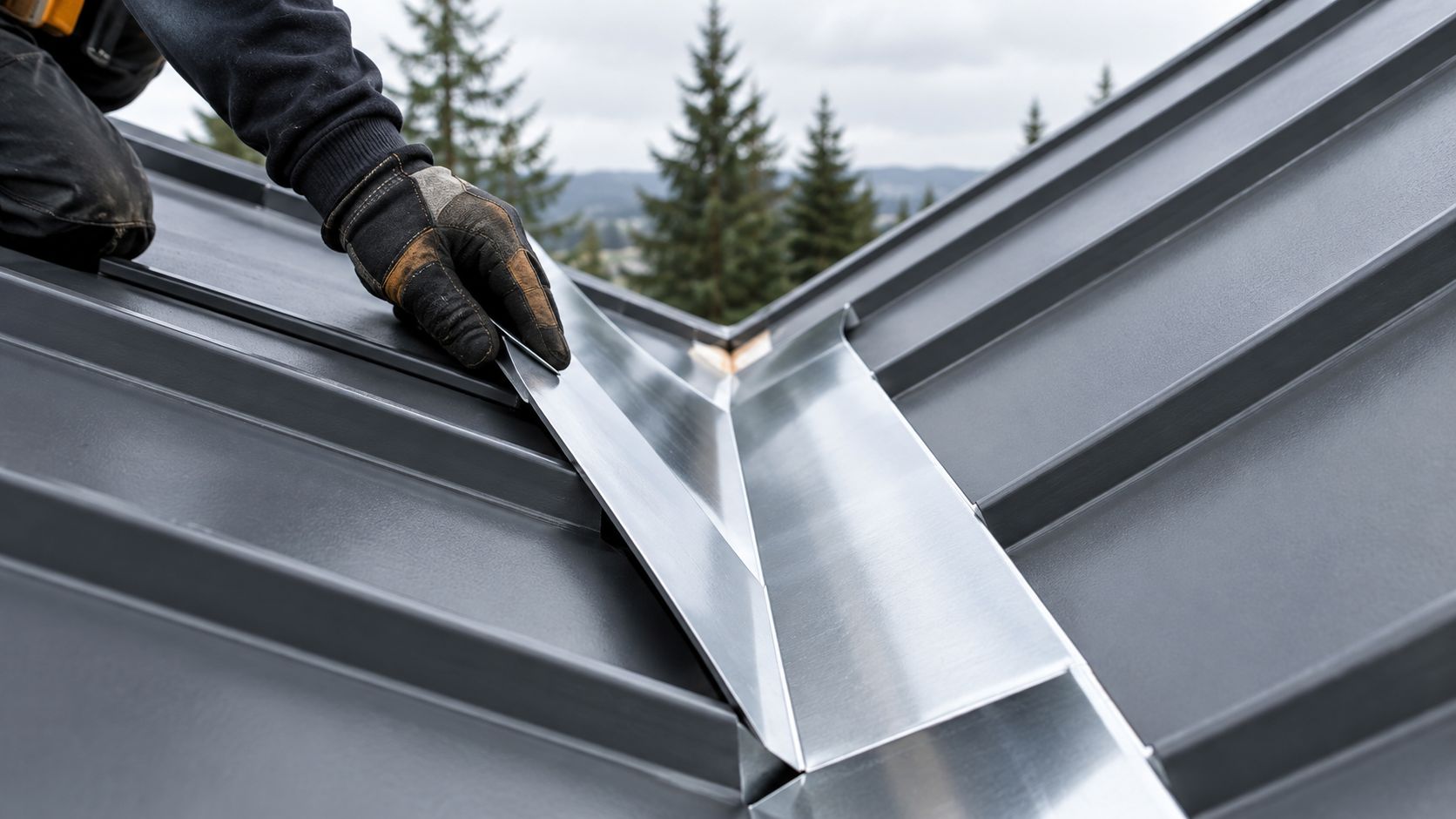
How to Do Valleys with Metal Roofing in Oregon
If you've ever watched a steady Oregon rain turn a roof valley into a fast-moving chute, you already know why this detail matters. The problem isn't the roof field, it's the inside corner where water from two slopes gets forced into one path, and if that path is built wrong, the leak usually shows up when the weather is doing its worst.
Metal roofing can handle our wet seasons well, but valleys need more care than the rest of the roof. In western Oregon, that means thinking about runoff, moss, fir needles, wind-driven rain, and how the metal moves when temperatures swing.
Table of Contents
- Why Roof Valleys Matter in the Pacific Northwest
- Choosing Open Metal Valleys Over Closed Methods
- Sizing the Valley Metal for Heavy Rain and Thermal Movement
- Installing the Underlayment and Flashing Layers
- Adapting Valley Details for Oregon Coastal and Valley Climates
- Inspecting Your Valleys and Knowing When to Call a Professional
Why Roof Valleys Matter in the Pacific Northwest
A valley on a roof is where two slopes meet and water gets funneled hard into one channel. In Salem or Keizer, that can mean a mild shower turns into a constant sheet of water at the valley, and in Lincoln City or Newport the same detail has to handle wind-driven rain and salt air too. Roof valleys are the channel where two sloping roof planes meet, and the NRCA roofing guidance says open valleys are built by installing a metal lining over the valley underlayment using corrosion-resistant metal. NRCA roofing guidance
A valley isn't just another seam. It's the place where water, debris, and movement all collide, which is why the workmanship has to be tighter there than anywhere else on the roof.
What the valley is really doing
The valley has one job, move water off the roof fast and cleanly. That's easy to say and hard to do when two roof planes are dumping runoff into the same spot for months at a time.
Practical rule: if a valley can't stay clear, it can't stay dry for long.
On metal roofs, the valley usually uses exposed flashing rather than relying on shingles alone to cover the joint. That gives water a defined path and leaves less chance for trapped moisture, especially in our long wet seasons. The same basic logic helps in the mid-Willamette Valley, the Portland metro, and along the coast, because the weather here doesn't give a roof many breaks.
Why metal valley work needs a different mindset
Asphalt valley details and metal valley details aren't built the same way. Metal tends to move more noticeably with temperature changes, so the installation has to allow for that movement without wrinkling the flashing or loading stress into the fasteners.
The finish line isn't just a neat-looking seam. It's a valley that sheds water, stays flat, and keeps working when debris, moss, and wind put pressure on it season after season.
A short video helps show the basic water path through a valley.
Choosing Open Metal Valleys Over Closed Methods
Homeowners usually ask the same question first, open valley or closed valley. Closed valleys can look cleaner from the street, because the shingles overlap or weave across the valley and hide the metal, but that clean look can come with more maintenance and less forgiveness when debris builds up or water volume gets heavy.
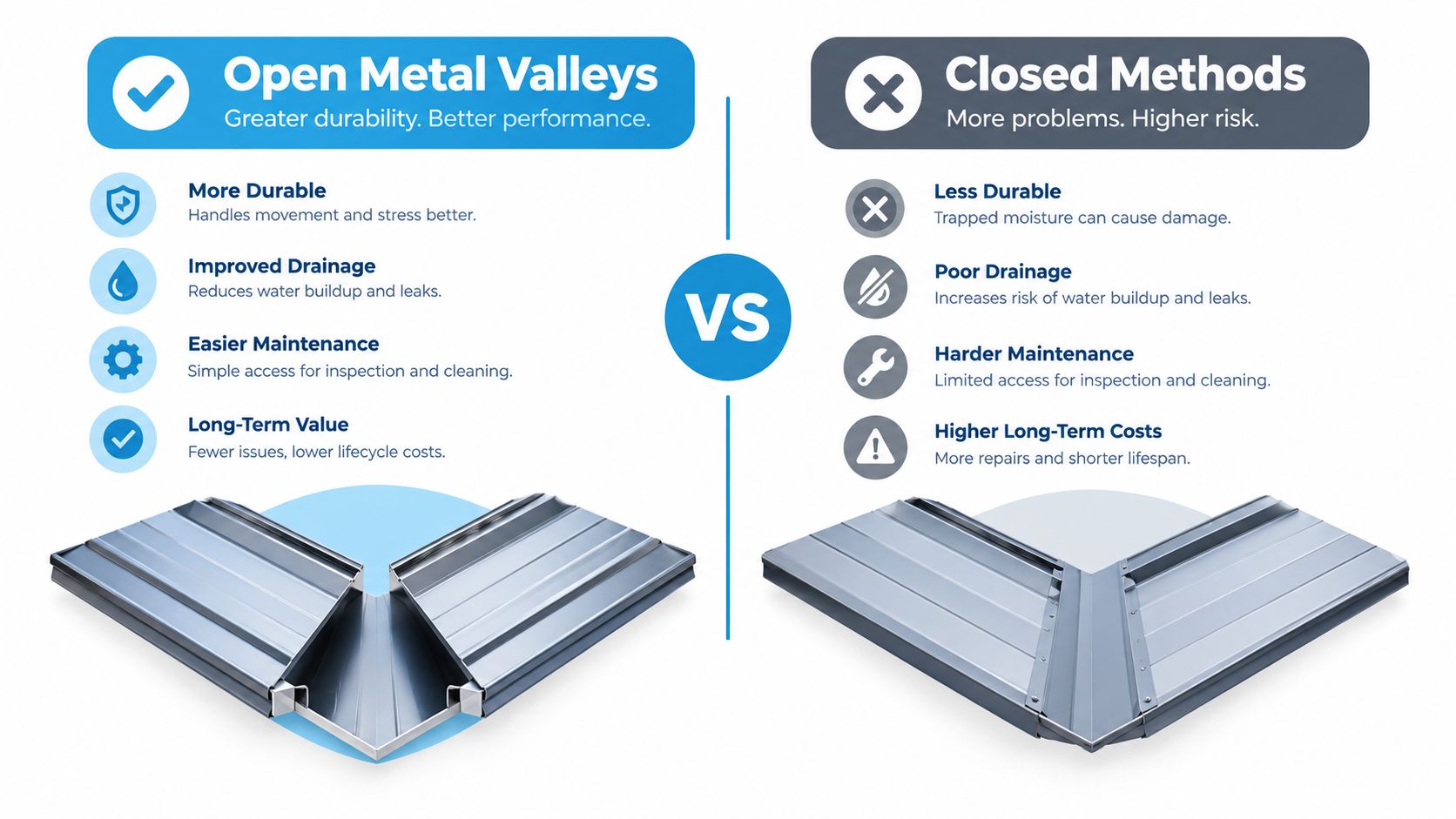
Open metal valleys leave a visible channel, so water and debris have a clearer route out. Recent mainstream guidance increasingly treats open metal valleys as the safer default for high-flow roofs, with manufacturers noting that the visible metal flashing and W-shaped profile help prevent water from jumping the valley and avoid the problem of meshing panels from two roof planes. Manufacturer guidance on open metal valleys
What open valleys do better in wet weather
Open valleys are easier to inspect from the ground, easier to clean, and less likely to trap fir needles or moss mats. That matters in Oregon, where a valley can go from clear to clogged after a few windy storms.
Closed valleys still show up on some homes, and they can work when the roof geometry is simple and the installation is precise. The weak point is that the performance burden shifts into hidden layers, so if debris or water gets past the top surface, you're depending on things you can't see.
Why exposed metal is often the safer default
For high-flow roofs, especially ones with complex intersections, exposed metal gives the water somewhere obvious to go. It also makes the valley easier to maintain without tearing up the surrounding roof system.
Metal roofing service options matter here because valley design isn't separate from the rest of the roof. The valley has to work with the panel layout, not against it.
Sizing the Valley Metal for Heavy Rain and Thermal Movement
The dimensions matter more than many realize. A valley that looks fine in dry weather can still fail if the metal is too narrow, too short, or installed in pieces that fight expansion and contraction.
The National Roofing Contractors Association recommends valley metal formed with a center-line rib at least 1 inch high and 24 inches wide, installed in lengths no longer than 10 feet to control thermal movement and reduce distortion where expansion and contraction are greatest. NRCA valley flashing requirements
Why width and piece length matter
That 24-inch width gives the installer a standard drainage path between the two roof planes. In practice, it gives runoff room to move without crowding fasteners or curling up at the edges when the valley sees a lot of water.
Shorter piece lengths help too, because long metal runs are more likely to wrinkle or oil-can as the roof heats and cools. If a contractor wants to run an overly long piece through the valley, that's a good time to ask how they're handling movement.
How water volume changes the layout
A valley that runs a long distance down a roof usually needs a more generous exposed channel as it approaches the lower end, because runoff volume increases downslope. That's one reason valley width is more than a single number on a sheet of paper, it has to fit the roof shape and the amount of water that's coming through it.
A valley should be sized for the roof it's on, not for the easiest cut in the shop.
What to ask a contractor
If you're reviewing a proposal, ask about these details:
- Flashing width: Is the valley metal at least 24 inches wide?
- Piece length: Are the valley sections kept to 10 feet or less?
- Movement control: How is thermal expansion handled at the seams and fasteners?
- Drainage path: Does the exposed channel stay open enough for the roof pitch and valley length?
Those questions sound technical, but they're really just a way to find out whether the contractor is building for Oregon weather or for speed.
Installing the Underlayment and Flashing Layers
A proper valley starts below the visible metal. If the underlayment and valley membrane are sloppy, the metal doesn't get a fair shot, and that's where a lot of leaks begin.
Roofing practices manuals specify that valley protection membrane must be at least 39 inches wide and centered on the valley, with metal valley panels overlapped by at least 8 inches and secured with non-corrosive fasteners spaced 8 inches on center to allow for thermal movement. RCABC valley detail)
The layering order that actually works
First comes the roof deck, then the centered valley protection membrane, then the metal valley flashing, then the roof panels trimmed to meet the valley cleanly. That sequence matters because the hidden membrane is the backup if wind-driven rain gets under the visible flashing.
The overlap numbers matter for the same reason. An 8-inch overlap gives the valley panel enough bearing where sections join, and non-corrosive fasteners reduce the chance that the fastener heads themselves become a long-term rust point in wet air.
How the panels should meet the valley
The roof panels should be cut and hemmed cleanly where they meet the valley, with no raw edge left flapping in weather. Fasteners belong where they won't interrupt the water path, and drag-load fastening is used so the metal can move a little without buckling.
If you see a valley with fasteners stuck right in the middle of the drainage path, that's not a small detail. It's a future leak point.
A note on materials and repair work
This is the part of the job where the little things matter most, like which fasteners are used and how the lap is set. For homeowners comparing roof systems or repair options, Safeguard Roofing LLC handles roof replacement, roof repair, and metal roofing work that can include these valley details, but the main question is always the same, whether the assembly is built to stay dry in a long Oregon rainy season.
Adapting Valley Details for Oregon Coastal and Valley Climates
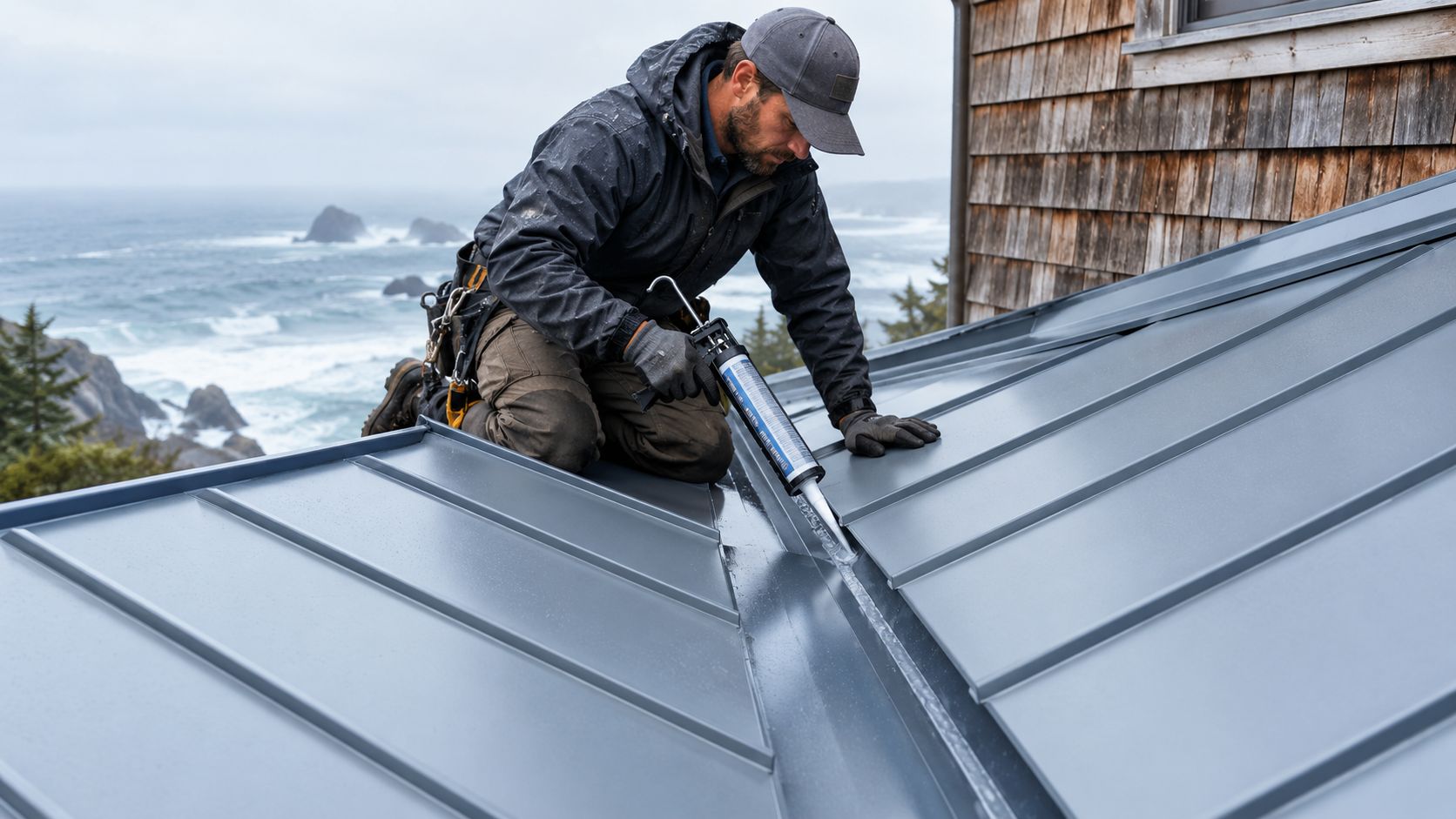
A roof valley in Newport has different stress than one in Albany or Portland. Near the coast, salt air is a real concern, because it can be harder on metal and fasteners over time, so material choice and fastening choice matter more than they might inland.
Coastal homes need a corrosion-minded approach
On the central Oregon coast, the valley should be built with corrosion resistance in mind from the start. That means the flashing, fasteners, and any exposed metal details need to be chosen for damp, salty conditions, not just for appearance.
In the Willamette Valley and Portland metro, the bigger problem is often debris. Fir needles, moss, and algae can collect in the valley and hold moisture against the metal, which slows drainage and can push water where it doesn't belong.
Maintenance depends on the neighborhood, not just the roof
A valley in a tree-heavy neighborhood needs more cleaning than a valley on a more open lot. The same goes for roofs under heavy shade, where moss likes to linger after rain.
Useful maintenance habits include:
- Keep the valley clear: Remove needles and leaf buildup before it mats down.
- Watch the exit point: Make sure the valley drains cleanly into properly sized gutters.
- Check the visible metal: Look for rust spots, lifted edges, or wrinkling from the ground.
- Plan work for the dry season: Late spring through early fall usually gives Oregon roof crews a better weather window for repairs and replacement.
Local work still needs local paperwork
If any valley repair turns into a bigger roofing project, verify the contractor's Oregon CCB license before the work starts. Oregon requires anyone doing construction work for compensation, including roofing, to be licensed with the Oregon Construction Contractors Board, which includes pre-license training and passing a state exam to ensure proper standards are met. Oregon CCB licensing requirements
Service area details are useful too, because a local crew is more likely to understand the rain, wind, and salt patterns that shape valley performance here.
Inspecting Your Valleys and Knowing When to Call a Professional
You don't need to climb on the roof to catch early valley problems. A ground-level check with binoculars, or a look from a safe upstairs window, can tell you a lot before a leak shows up inside.

Warning signs you can spot from the ground
Look for wrinkled metal, rust around fastener heads, dark streaking where moss or debris is holding water, and any place where the valley looks bent instead of flat. If the valley edge looks lifted, or if you can see debris collecting after every storm, the drainage path probably isn't working like it should.
Interior signs matter too. Ceiling stains below a valley, peeling paint on nearby walls, or damp spots after a hard rain mean the problem may already be active.
What can wait and what can't
A light cleaning may be enough if the valley is clear, the metal is flat, and there are no rust spots or stains inside. A visible wrinkle, repeated clogging, or any sign of water getting under the panels deserves a professional look.
Don't walk on a metal roof, especially when it's wet, frosty, or covered in morning dew. Valleys are especially easy to damage because the metal is doing concentrated work there, and DIY repairs often make the leak worse.
When to bring in a roofer
Call a professional if you see recurring overflow, damaged flashing, fastener corrosion, or signs that the valley is holding water. For any repair work, verify the Oregon CCB license first, and if the issue turns into a broader roof problem, a roof replacement evaluation may be the better call than patching one visible spot.
Roof replacement services are worth reviewing when valleys keep failing, because repeated valley leaks often point to a larger roof system issue, not just one loose piece of metal.
If your metal roof valley is showing rust, wrinkling, or repeated debris buildup, Safeguard Roofing LLC can inspect it, repair it, or talk through a replacement plan that fits Oregon weather. Call 971-518-0028 or visit Safeguard Roofing LLC to request a free written estimate and get a straight answer about what your valley needs.