
Asphalt Shingle Repair: Fix Leaks Before They Spread
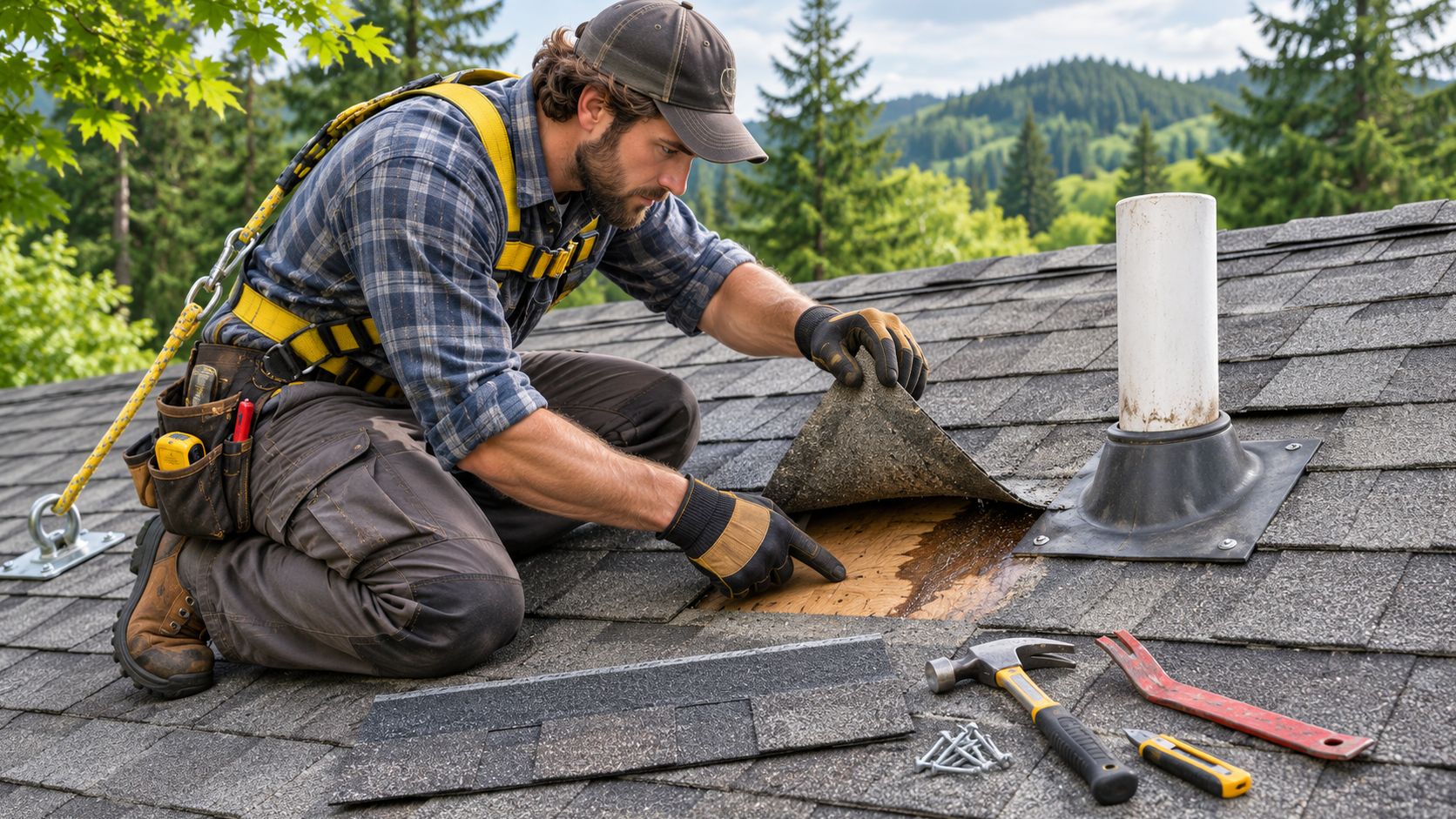
The ceiling stain has grown since last night's rain, and there's a shingle lying beside the driveway. You're wondering whether this is a small repair or the start of a roof replacement. In western Oregon, the answer starts with where the water gets in, not where it finally drips.
Long wet seasons, moss, Coast Range wind storms, and coastal salt air make a surface-only patch a poor bet. Good asphalt shingle repair restores the roof's drainage layers and corrects the failed component. Smearing cement over the wet area may hide the problem without stopping it.
Table of Contents
- Match the Symptom to the Right Shingle Repair
- How a Shingle Repair Is Done Step by Step
- Stop the Leak Before the Repair Crew Arrives
- Replacing Stepped Flashing and Vent Boots
- Why Repairs Fail Without Checking Ventilation and Moss
- Knowing When a Patch Is Enough or a New Roof Is Needed
- Verify the CCB License and Book Your Repair
Match the Symptom to the Right Shingle Repair
| Symptom | Likely cause | Typical fix | Call a pro? |
|---|---|---|---|
| Ceiling stain after heavy rain | Water entering at flashing, vent boot, or penetration | Replace the component, then the shingles around it | Yes, active leak, call now |
| Missing or slipped shingles after wind | Wind lifted or unsealed tabs | Replace shingles and reseal tabs | Yes, before the next storm |
| Curling or cracked shingle edges | Age and brittle asphalt | Replace affected shingles, or the whole roof if widespread | Yes, schedule it if it isn't leaking yet |
| Moss or algae streaks on shaded slopes | Long wet periods under fir trees and shade | Gentle cleaning, then check for lifted edges and exposed nails | Yes for roof work, before the fall rains |
| Dark wet spots on attic sheathing | Condensation or blocked ventilation, though leakage is also possible | Check the moisture source, balance intake and exhaust, and check baffles | Yes, at the repair visit |
| Granules collecting in gutters | Aging shingle surface | Monitor, and inspect if losses repeat | Not urgent, note it for the next inspection |
These are starting points, not diagnoses. A stain beside a pipe doesn't prove the pipe boot failed, and dark sheathing doesn't automatically mean condensation. The contractor needs to connect the symptom to its source.
Walk the yard and use binoculars from the sidewalk to look for bare patches, crooked shingle courses, and lifted edges. Check gutter discharge for granules after rain. Remove leaves only where you can reach them safely from the ground with an appropriate gutter-cleaning tool.
What shade changes
The Oregon Department of Agriculture and Washington State University demossing guide identifies surfaces that remain wet for long periods as common moss trouble spots. That fits shaded roofs beneath fir trees in the Willamette Valley and around Lincoln City and Newport. Moss can hold moisture and lift edges; algae discoloration alone doesn't establish that shingles need replacement.
On a dry day, inspect an accessible attic with a flashlight from secure flooring. Look around pipes, the chimney, and wall lines without stepping onto insulation or ceiling drywall.
Practical rule: Roof-surface work and attic-moisture correction belong to professionals. Light, isolated granule shedding without leaks or bare asphalt can wait for the next inspection, but repeated loss needs attention.
How a Shingle Repair Is Done Step by Step
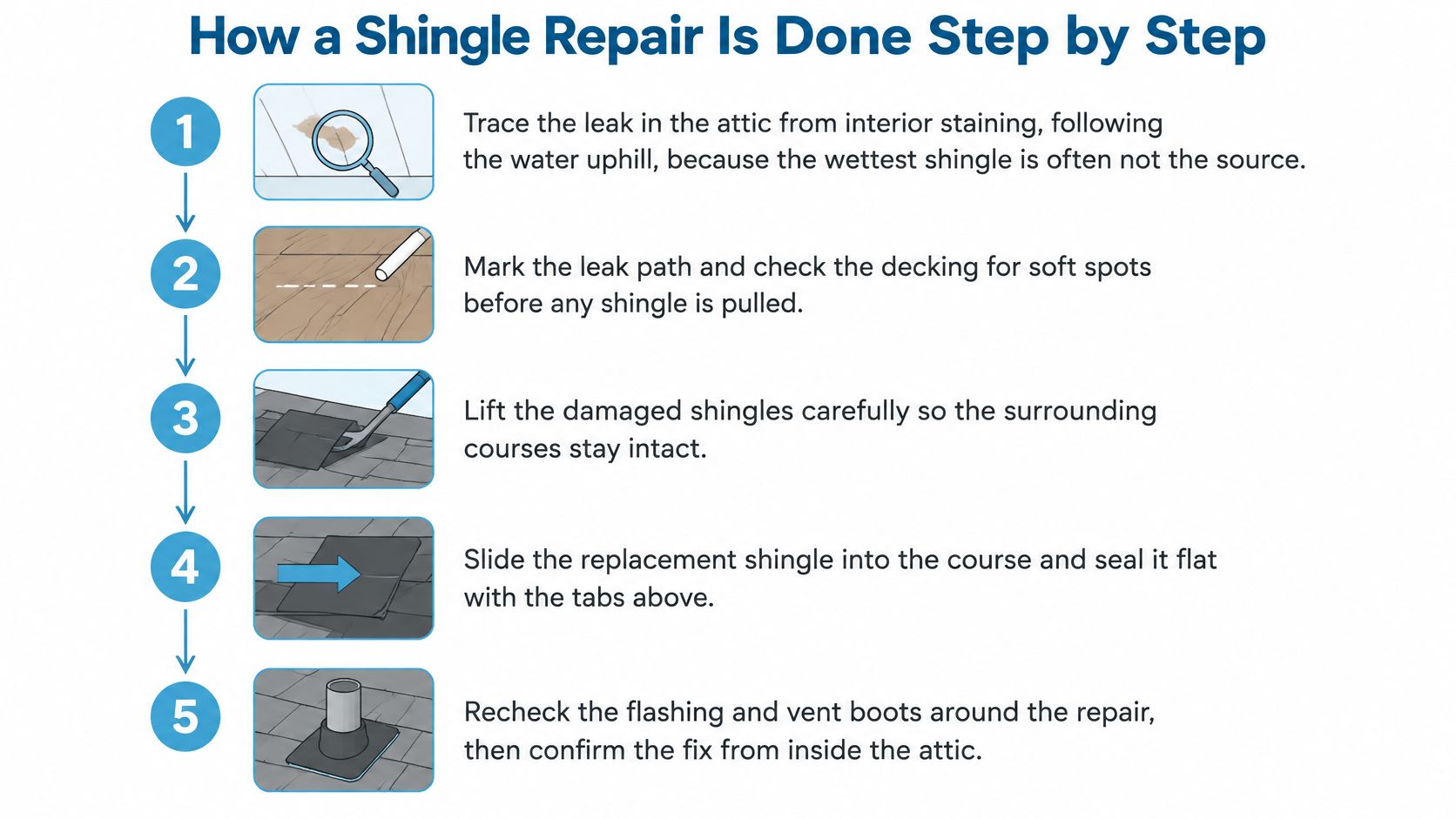
A contractor should be able to explain the repair sequence before pulling shingles. Homeowners can use this process to evaluate the proposed work, not as instructions to climb onto the roof.
Trace the water path. The crew compares interior staining and attic evidence with the roof above. Water can travel along decking or framing, so the wettest location isn't necessarily the entry point.
Inspect the surrounding details. Before disturbing shingles, the roofer checks upslope penetrations, wall intersections, valleys, eaves, and flashing. This prevents replacing a damaged-looking shingle while leaving the actual opening untouched.
Remove damaged material carefully. The roofer breaks the adhesive bond and extracts fasteners without tearing neighboring shingles or the underlayment. If surrounding shingles crack when lifted, the repair area may need to expand.
Correct the failed component. Deteriorated flashing or a defective pipe boot gets replaced before the surrounding shingles go back. The Asphalt Roofing Manufacturers Association's flashing guidance calls for purpose-fitted pipe flashing integrated with the shingles, rather than relying on cement alone.
Install compatible shingles. The replacement must suit the existing thickness, exposure, seal-strip position, and fastening requirements. We match the existing roof's color and profile as closely as possible, but color alone doesn't establish compatibility.
On coast homes, repairs often mean resealing rake edges and adding fasteners, not just swapping a shingle. Those fasteners must follow the roof system's requirements, not an improvised pattern of exposed nails.
Seal and verify. The crew uses compatible roofing cement only where the assembly calls for it, checks drainage, and performs a controlled water test where appropriate. Confirmation includes checking the interior, not just photographing a finished patch.
This overview illustrates the professional workflow.
What belongs in the written scope
The estimate should identify the water-entry point, components being replaced, and repair boundaries. It should distinguish a targeted shingle repair from flashing correction, deck repair, or replacement of a larger failed area. Oregon's CCB specialty-license guidance treats roofing and related structural components as regulated work, which is another reason to evaluate the assembly rather than just cover the stain.
Soft decking, broadly degraded underlayment, or shingles too brittle to handle are reasons to stop and revise the scope. Covering those conditions with fresh shingles doesn't produce a sound repair.
Stop the Leak Before the Repair Crew Arrives
Keep everyone off the roof. Wet asphalt shingles are slick, and a storm-damaged surface may not support a person safely.
Inside, move furniture and electronics away from the drip and place a bucket beneath it. Photograph the stain beside a ruler for scale. If water is near electrical fixtures or the ceiling is bulging, keep clear of the area and seek urgent help.
Safe information to gather
- Attic observations: On a dry day, look from secure flooring with a flashlight. Note staining above and uphill of the ceiling mark without touching wiring or wet materials.
- Drainage conditions: From the ground, remove reachable leaves and fir needles at gutter or valley discharge points. Leave inaccessible blockages to the crew.
- Weather pattern: Record whether the stain grows during steady rain or wind-driven rain, including storms from the south or southwest.
A professional tarp is temporary protection, not a reason to postpone the permanent repair through another wet season.
Ask about storm protection when you book. Don't attempt your own tarp installation, and don't wait for the fall rains to arrange an inspection.
Replacing Stepped Flashing and Vent Boots
A split pipe collar or failed flashing joint can look like a shingle leak from inside the house. The important distinction is whether the crew replaces the defective water-shedding component or coats its surface.
This close-up shows the pipe-boot area a roofer needs to examine.
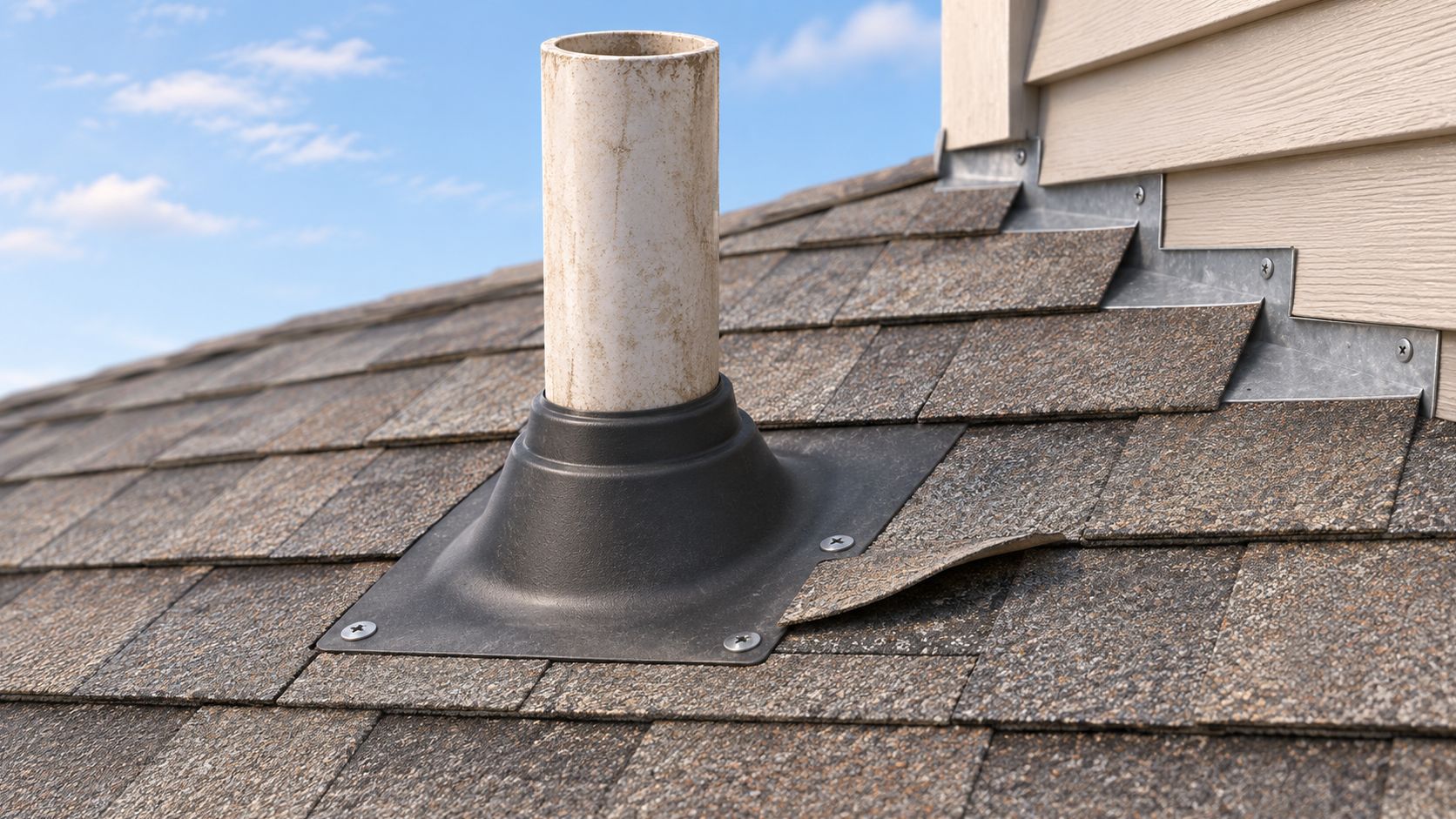
A vent pipe needs a fitted boot or flashing flange integrated into the shingle courses so water passes onto the roof below. A cracked collar calls for component replacement, not a thick bead of caulk around the split. Cement may temporarily obscure the entry path while leaving the underlying defect in place.
Small component or larger flashing section
Step flashing is woven into successive shingle courses along walls and chimney sides. Lifted pieces, corrosion, misplaced fasteners, or failed surrounding joints can require opening the courses to rebuild the detail correctly. Coastal salt air makes checking metal condition and fastener compatibility particularly important.
- Split vent boot: If adjacent shingles and decking remain sound, this is a localized repair that a crew can often complete in a visit.
- Several lifted chimney flashing pieces: The roofer may need to rebuild a larger section. Get the boundaries and replacement components in writing.
The following video provides another visual reference for roof repair details.
From the ground, look for rust streaks beneath vents or visible gaps at the chimney base. From a safely accessible attic, note stained framing around pipes and wet insulation near wall plates. Active staining near a penetration is urgent during the wet season; a dry, intact boot can be reviewed at the next inspection.
On an older, faded roof, a correctly selected patch may remain visible up close. Judge the work by the rebuilt drainage detail, not a promise of invisible color matching or a guaranteed component lifespan.
Why Repairs Fail Without Checking Ventilation and Moss
A new shingle doesn't fix an attic moisture problem. If condensation keeps wetting the underside of the deck, replacing material outside leaves the cause untouched.
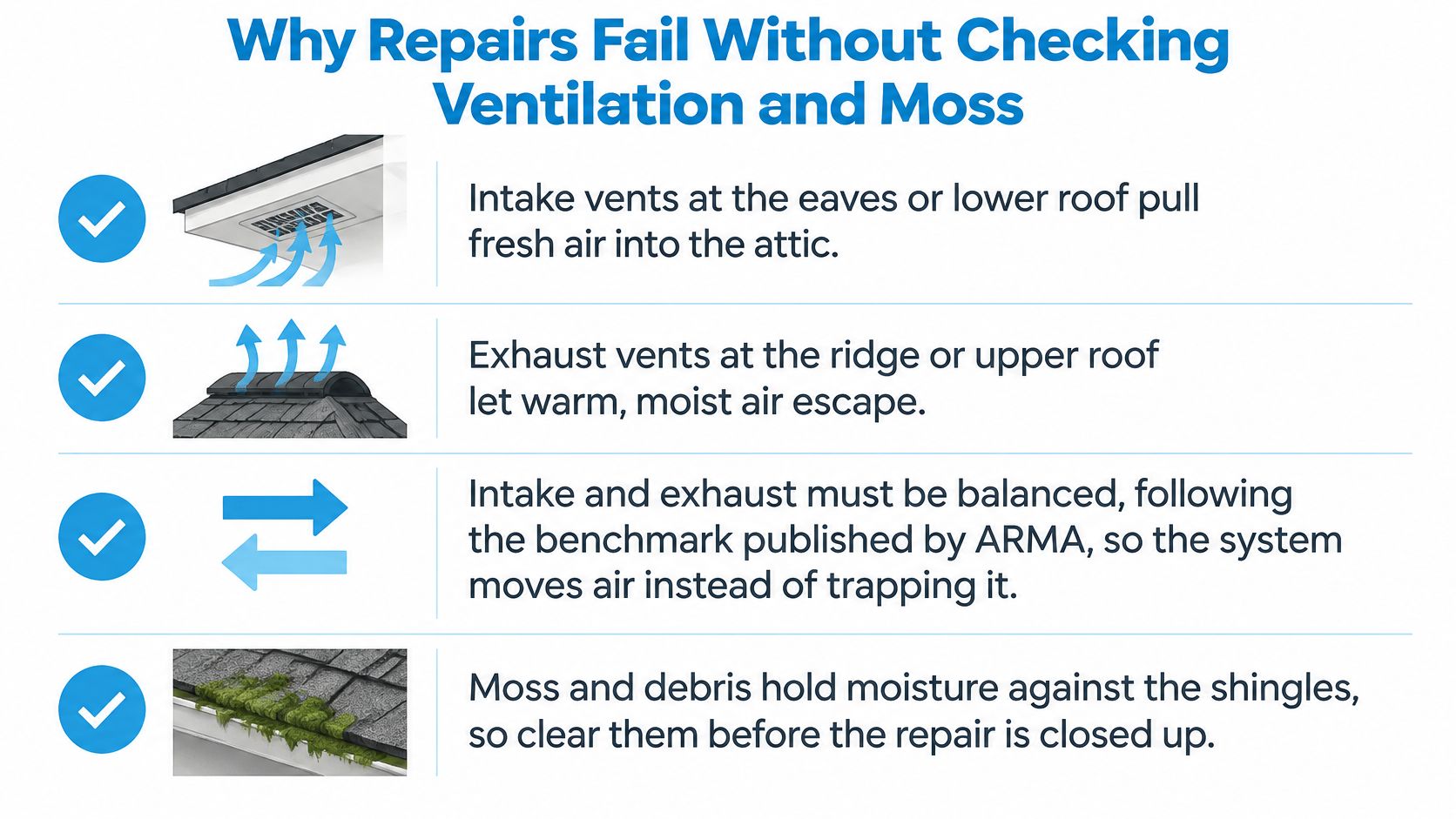
A balanced arrangement uses intake at the eaves or lower roof and exhaust near the ridge or upper roof. The ARMA ventilation bulletin gives a benchmark of at least 1 square foot of unobstructed net-free ventilation per 300 square feet of attic floor, with 1:150 preferred where conditions and design permit. Those calculations use net-free opening area, not a vent's outside dimensions.
The checklist below shows why the whole assembly matters.
Checks that change the repair scope
- Intake openings: The contractor checks whether insulation, paint, or debris blocks soffit vents.
- Air channels: Baffles need to preserve a clear route beneath the roof deck.
- Moisture sources: The inspection should identify bathroom or kitchen exhaust terminating in the attic, without treating another roof vent as the cure.
- Balanced airflow: Adding ridge exhaust without adequate intake can disrupt intended airflow and potentially draw moisture into the assembly during wind-driven rain.
Our explanation of roof ventilation systems helps homeowners understand the difference between adding vents and establishing a working airflow path.
Cleaning must expose defects without creating them
Moss removal should leave the protective granules intact. Aggressive scraping and forceful washing can turn a cleaning job into shingle damage. After gentle treatment, the roofer should examine lifted edges and exposed fasteners, then clear fir needles and debris that obstruct valleys.
Zinc strips can form part of a moss-control plan, but they aren't a repair for damaged shingles. Ask for deck condition and ventilation findings in the written scope, so you can distinguish a localized weather defect from a broader moisture problem.
Knowing When a Patch Is Enough or a New Roof Is Needed
Condition and failure pattern matter more than age alone. An older roof with a localized component failure may still deserve repair. A newer-looking roof with widespread unsealed tabs or hidden deck damage may require a larger intervention.
| Roof condition | Usually repair | Usually replace |
|---|---|---|
| One or two slipped or missing shingles | Yes, replace and reseal | Only if many shingles are affected |
| Failed vent boot or single flashing defect | Yes, replace the component | Only if flashing failure is widespread |
| Brittle shingles shedding granules across the roof | No, patching cracks more shingles | Yes |
| Leaks in several slopes | No, a patch treats one symptom | Yes, multiple failure points can indicate widespread aging |
| Soft or rotted deck under repair area | Repair the deck first, then shingles | Replace the section if decking damage is extensive |
The damaged area below illustrates why an assessment must include both shingles and penetrations.
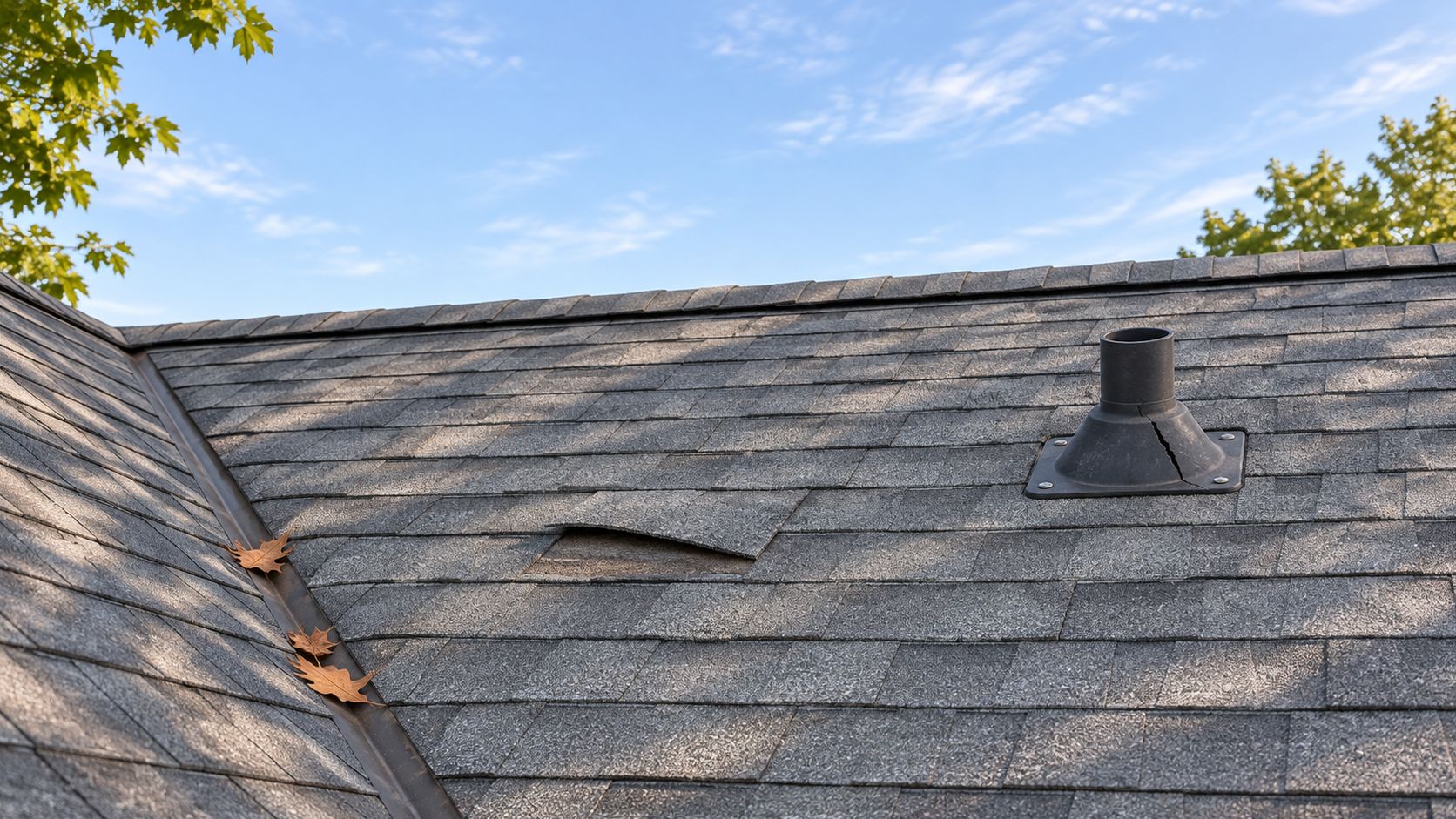
The difficult middle ground
A roof can look acceptable from the street while losing wind resistance. Verisk's roof-risk assessment reports that approximately 29% of U.S. homes with asphalt shingles have fewer than four years of remaining useful roof life. That national finding isn't a diagnosis of your roof, but it reinforces the value of assessing remaining condition rather than appearance alone.
Unsealed tabs deserve particular attention before another Coast Range windstorm. A small patch can stop a localized leak while leaving distributed weaknesses elsewhere. Our guide to roof life in Oregon explains how local exposure affects that decision.
Compatibility can also limit a repair. If a discontinued shingle can't be matched dimensionally and functionally, expanding the work may be more dependable than forcing an unsuitable product into the existing courses.
If the leak comes from a component and the rest of the roof has years left, we recommend repair. If shingles are brittle and shedding granules across the whole roof, replacement is the better spend.
After storm damage opens a roof, professional tarping can protect the interior while permanent work is scheduled. For a roof with several distributed failures, get a written repair-versus-replacement comparison before committing to repeated patches.
Verify the CCB License and Book Your Repair
A low verbal price isn't enough reason to hire someone to work above your living room. The Oregon Construction Contractors Board identifies roofing as work requiring a CCB license and describes the associated bond, general liability insurance, and employee workers' compensation requirements. Verify any contractor's active license and correct residential endorsement through the state's public lookup before work begins.
Safeguard Roofing LLC is a family-run contractor established in 2020, serving the Willamette Valley, the Portland metro, and the central Oregon coast. We're a licensed and bonded Oregon CCB contractor, CCB #25564.
Before approving the job
- Verify coverage: Confirm bond and general liability insurance information, plus workers' compensation when the contractor has employees.
- Settle permits: Ask your city or county whether the specific scope requires a permit and confirm who obtains it. Requirements differ by jurisdiction and scope, so ask rather than assume.
- Get an itemized scope: It should name the water-entry point being corrected, the materials and components going in, and the provision for concealed deck damage found once shingles come up. A quote that doesn't trace back to a diagnosed entry point is a quote for a patch that may only hide the leak for a season.
- Compare equivalent work: A surface-sealant price isn't comparable to removal and replacement of failed flashing.
- Ask about the inspection itself: The visit should cover deck and ventilation conditions, not only the surface shingle you can see from the ground.
For more hiring considerations, use our guide to evaluating Salem roofing companies.
Price and timing
Small flashing and boot repairs from Safeguard Roofing LLC usually cost a few hundred dollars. Larger repairs cost more when access is difficult, the pitch is steep, decking is damaged, or the affected area extends beyond a localized detail. A written, itemized estimate is more useful than a broad price range that ignores those conditions.
Late spring through early fall is generally the most practical window for planned roof work in western Oregon, though suitable weather windows matter more than the calendar. Active leaks shouldn't wait for summer. Before the visit, note where ceiling stains appear and check the attic after a rain, since that gives the estimator a starting point for tracing the entry. Our process begins with a visit to look at the roof, followed by a real price and an honest repair-or-replace option.
Safeguard Roofing LLC offers roof inspections, asphalt shingle repair, and storm and wind damage repair aimed at the actual water-entry point rather than the stain it left. Request a written, itemized estimate through the website to find out whether your roof needs a targeted repair or a larger correction.