
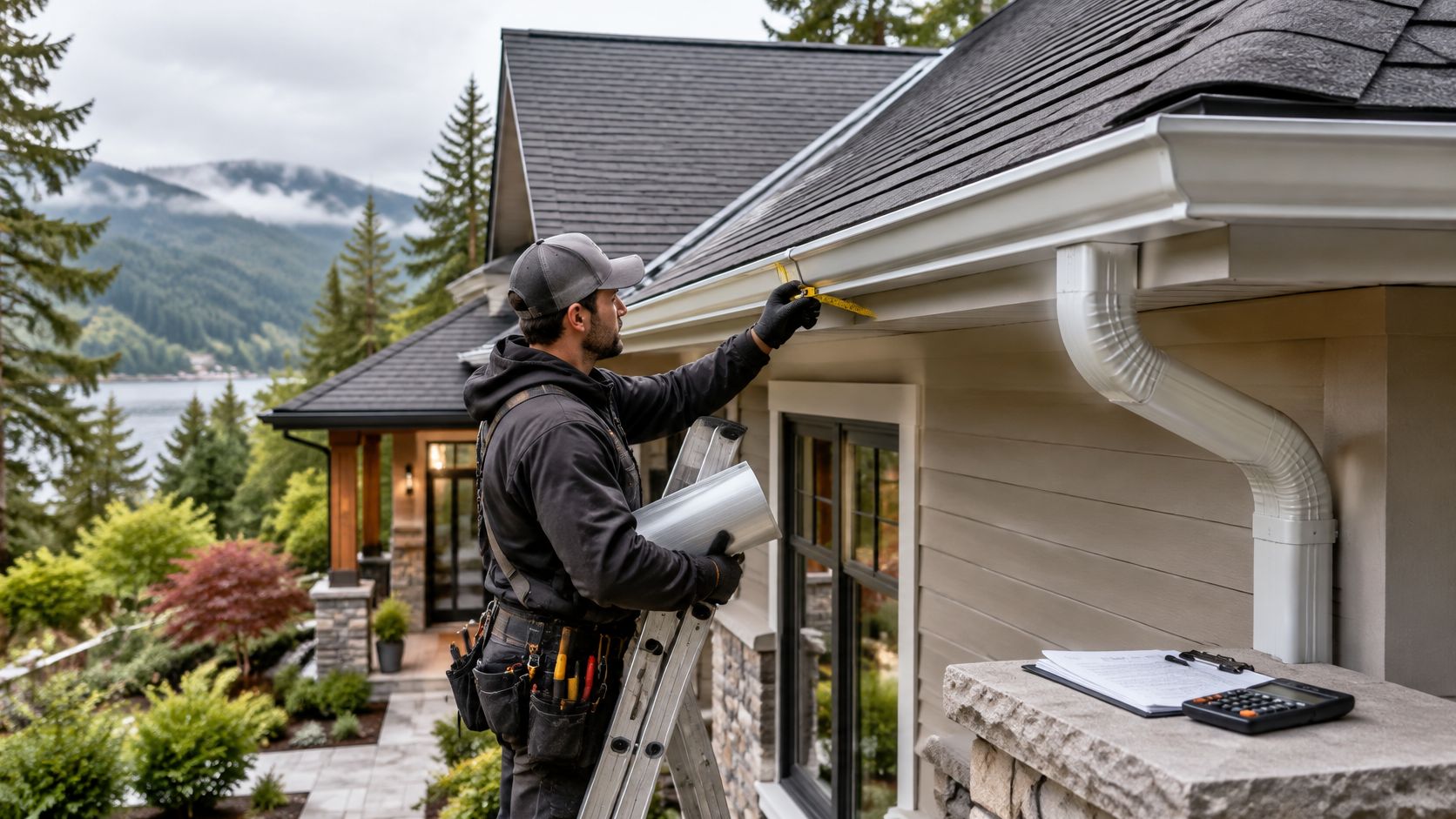
Seamless Gutters Cost Per Foot in Oregon
Aluminum gutters commonly run about $6 to $12 per linear foot installed, and a typical house often lands between $900 and $2,400. In western Oregon the total moves with size, access, downspouts, guards, and fascia, and only a measured written estimate is a real price.
The seam itself is not what sets that number. A continuous run still needs pitch, outlets, hangers, and wood that can hold the load through a long wet season. Ads that lead with a single per-foot figure skip the work that changes the bill: matching the profile to the roof, repairing soft fascia, and locking a scope before the price drifts.
If you own a house in Salem, Keizer, the mid-Willamette Valley, Portland, or on the central coast around Lincoln City or Newport, read a bid as a drainage plan, not a coil price. Stay on the ground. You can see overflow, stained trim, and sagging runs without stepping on the roof.
Table of Contents
- Installed Seamless Gutter Prices by Material and Length
- Labor Access Guards and Fascia
- Five Inch or Six Inch for Oregon Rain
- Sample Totals for Valley and Coast Homes
- Preventive Maintenance ROI and Avoided Damage
- Get a Measured Written Estimate
Installed Seamless Gutter Prices by Material and Length
Aluminum is the common residential option, with published U.S. installed prices of about $6 to $12 per linear foot, according to The Gutter Report's seamless-gutter cost summary, which cites HomeGuide. At that range, 150 linear feet comes to roughly $900 to $1,800 before added access difficulty, fascia repair, accessories, or local labor differences. The same summary gives a broader typical project range of $900 to $2,400 when factors such as extra downspouts, guards, multistory access, or a broken-up roofline affect the work.
Those figures are for budgeting, not a price for a particular house in Salem, Keizer, Portland, Lincoln City, or Newport. Aluminum gutters are formed on site in 5-inch and 6-inch K-style, with the size matched to the roof area. The continuous runs have joints only at corners and outlets.
One published 200-linear-foot installation at $1,984 works out to $9.92 per foot, near the middle of the aluminum range, according to the same summary. SimplyWise's gutter installation cost guide puts a 200-foot aluminum system at roughly $1,200 to $2,400 before unusual access or major repairs. Steel runs higher in a 2025 estimate: about $8 to $20 per linear foot installed, according to HomeGuide as reported by The Roofing Brief. Copper costs well above aluminum and steel because the material and its slower, more precise fabrication add expense.
How to read the rows
Material-only figures are not finished installation prices. Angi's seamless gutter cost guide lists aluminum stock at about $4 to $9 per foot for a 150-foot system, while published installed ranges overall run roughly $3 to $25 per foot. The rows below apply the installed ranges to common lengths. They are planning figures, not quotes.
| Material | Installed per foot | About 150 feet | About 200 feet | What drives it |
|---|---|---|---|---|
| Aluminum | $6 to $12 | $900 to $1,800 | $1,200 to $2,400 | Common residential option; size matched to roof area |
| Steel | $8 to $20 | $1,200 to $3,000 | $1,600 to $4,000 | Higher installed range; consider corrosion exposure |
| Copper | Well above aluminum and steel | Higher than aluminum and steel | Higher than aluminum and steel | Material cost and slower, precise fabrication |
A material comparison does not tell you whether the system suits the roof or site. The right size and scope matter more than a low per-foot ad, especially where the roof needs to handle Oregon rain and fir needles.
Why last season's foot price isn't a promise
Aluminum mill-shape prices rose 30.5% year over year in 2025, according to construction price coverage from the Associated General Contractors of Florida. That change does not translate directly into the same increase in an installed price, since labor, truck time, hangers, and local demand also affect the total. A saved estimate from last fall may no longer hold.
Before anyone climbs a ladder, ask for a written estimate that spells out the material, length, size, downspouts, and work included. Safeguard Roofing's gutter services include on-site forming, pitched runs, and hidden hangers. Compare bids by scope and quote validity, not by the seam or per-foot price alone.
Labor Access Guards and Fascia
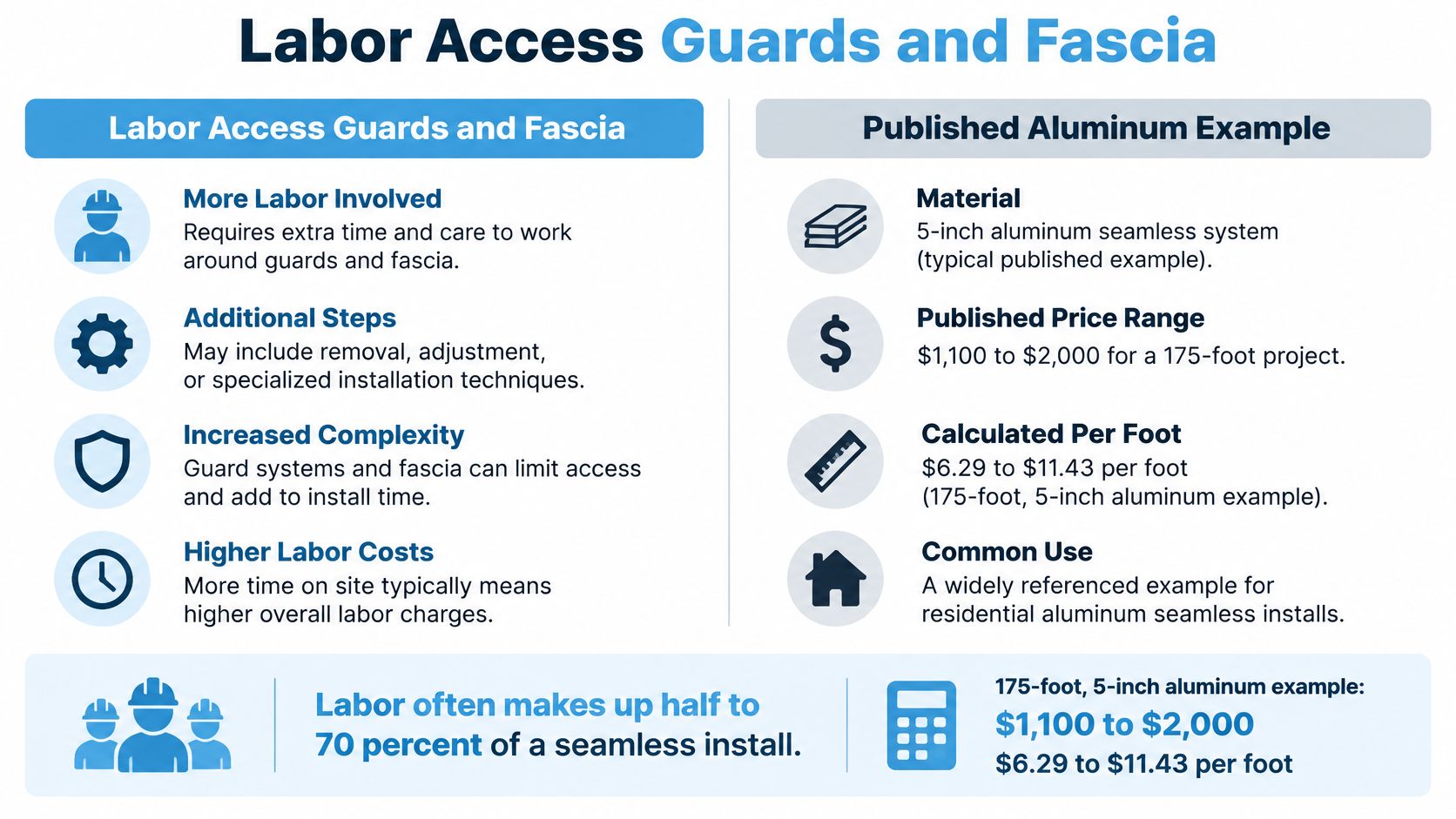
Labor is often the larger half of an installation, not a small add-on. Fixr reports that labor may account for about 50% to 70% of total installation cost. The same source estimates a 175-foot, 5-inch aluminum project at roughly $1,100 to $2,000, which works out to about $6.29 to $11.43 per linear foot. That spread is mostly time, not coil. Fixr also shows an installed range of about $14 to $20 per foot in another pricing frame, which is a reminder that national guides don't share one scope.
What the hours cover
A crew measures the eaves, brings a forming machine, sets continuous pitch, cuts outlets and corners, hangs the run, and checks that water leaves. The gutter is fitted to the building. It isn't a stack of short sections from a store shelf. A low coil price doesn't produce a low installed bid if the eaves are high, the corners are many, or the old metal has to come off first.
Practical rule: If one bid skips removal, downspouts, or wood repair, it isn't comparable to a full install, even when the per-foot number looks smaller.
Line items a per-foot ad hides
| Driver | Why it shows up | How it affects the bill |
|---|---|---|
| Labor and forming | Machine, slope, outlets, and hangers on site | Often about 50% to 70% of the total |
| Old gutter removal | Tear-off and disposal | Separate from the new per-foot price |
| Corners and outlets | Miters, end caps, and downspout drops | More fittings on complex eaves |
| Gutter guards | Needle-shedding covers | Extra material and fit time |
| Access | Two stories, steep roof, tight lot | More time and equipment |
| Fascia and drip edge | Soft or rotten wood behind the gutter | Repair before new gutter is hung |
| Edge supplies | Fasteners, brackets, basic flashing | Some guides near $3.50 per foot |
Old gutters come off, and fascia and drip edge get repaired as needed. Damaged fascia is replaced before the new run goes up, because new gutter needs solid wood behind it. Patching over rot just moves the failure to the next storm.
Guards built to shed conifer needles cost more up front and take fitting time. They're worth pricing when fir and cedar dump into the trough every fall. They aren't free, and they aren't a reason to skip outlets.
Access is the quiet multiplier on older Portland and Salem lots: two-story walls, steep pitches, and side yards too tight for a comfortable ladder setup. On the coast, wind and salt-worn wood slow the hang. Each of these items should appear on a written estimate. We don't publish a flat company price, because the footage and the wood aren't the same from one street to the next.
Five Inch or Six Inch for Oregon Rain
Five-inch and six-inch K-style gutters have different capacities. A sizing guide from LaPeyre Roofing gives about 1.2 gallons per linear foot for a 5-inch gutter and 2.0 gallons for a 6-inch gutter. Steep roofs shed water faster and concentrate it at the eaves, so the gutter may need more capacity than the roof's footprint alone suggests.
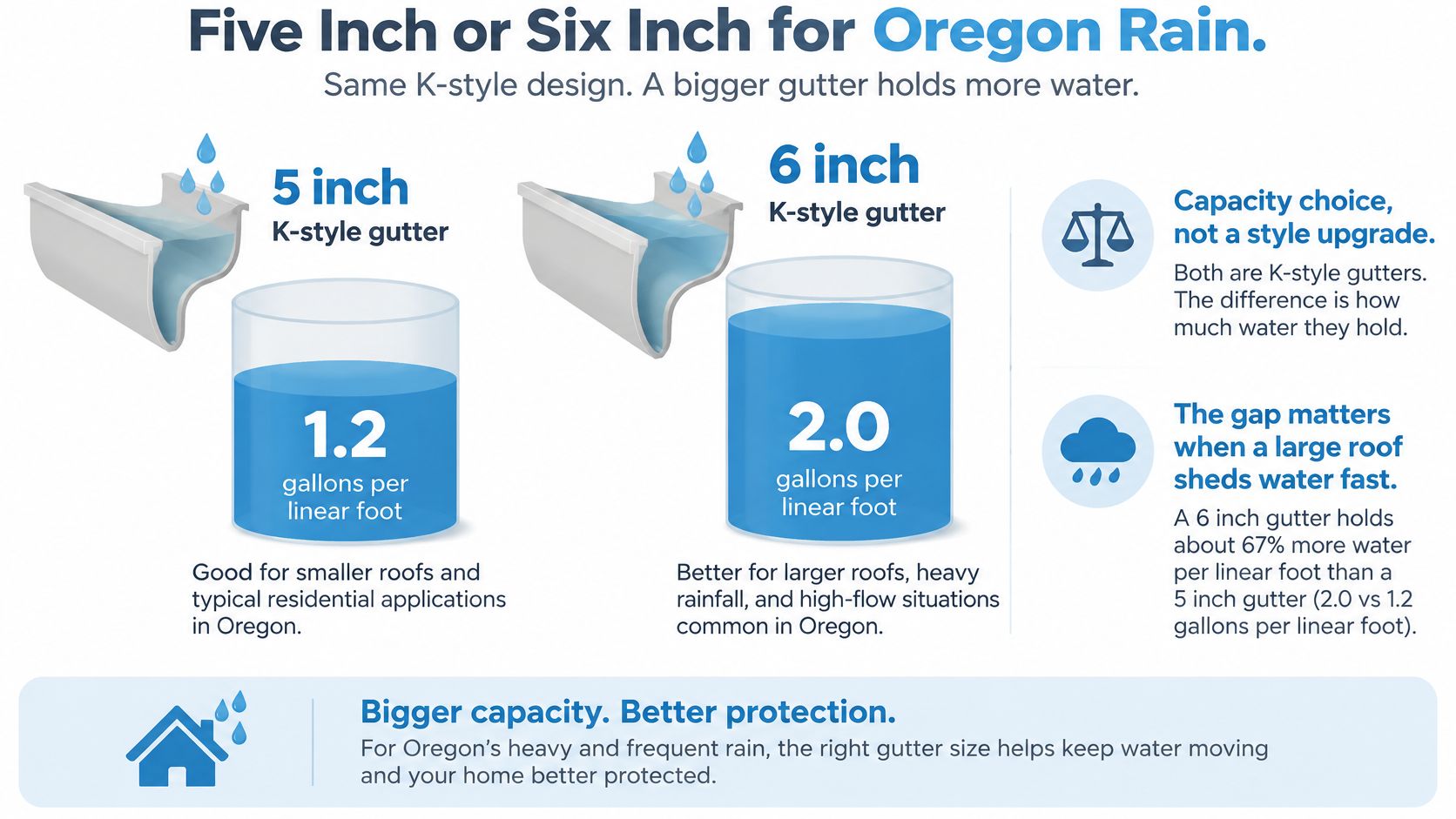
| Profile | Capacity per foot | Typical fit |
|---|---|---|
| 5-inch K-style | About 1.2 gallons | Single story, short runs, open discharge |
| 6-inch K-style | About 2.0 gallons | Large roof planes, valleys, dense needles, heavy rain |
Safeguard Roofing forms aluminum gutters on site in 5-inch and 6-inch K-style, sizing them to the roof area. Gutters, guards, and downspouts are selected for fir needles and Oregon rain. Under heavy tree cover, oversized or extra downspouts can help move water through the system.
Map each plane before you pick a profile
- Sketch the roof from the yard. Note each plane and the eave that catches its runoff. There's no need to climb.
- Mark the valleys. Water from two slopes concentrates where they meet.
- Count the downspouts and note where each one discharges. A downspout ending at a patio may leave water too close to the house.
- Compare the roof area, valleys, and outlets before choosing a profile.
A large plane or valley may need a 6-inch gutter and more outlets. Dense fir or cedar cover can also mean more debris at the outlets. On the central coast, wind-driven rain adds to the drainage demand. A single-story home with short runs and open discharge may suit 5-inch gutters.
From the ground, check for water spilling over the front edge, trenches in the mulch, or stained siding below a valley. A written estimate should specify the gutter profile and downspout size and count. The seam itself is not the main cost driver; matching capacity and outlets to the roof is what helps prevent overflow.
Sample Totals for Valley and Coast Homes
These three houses are illustrations using published aluminum planning bands. They are not bids. Tax, disposal, and city permit needs are left out on purpose, because those change by address.
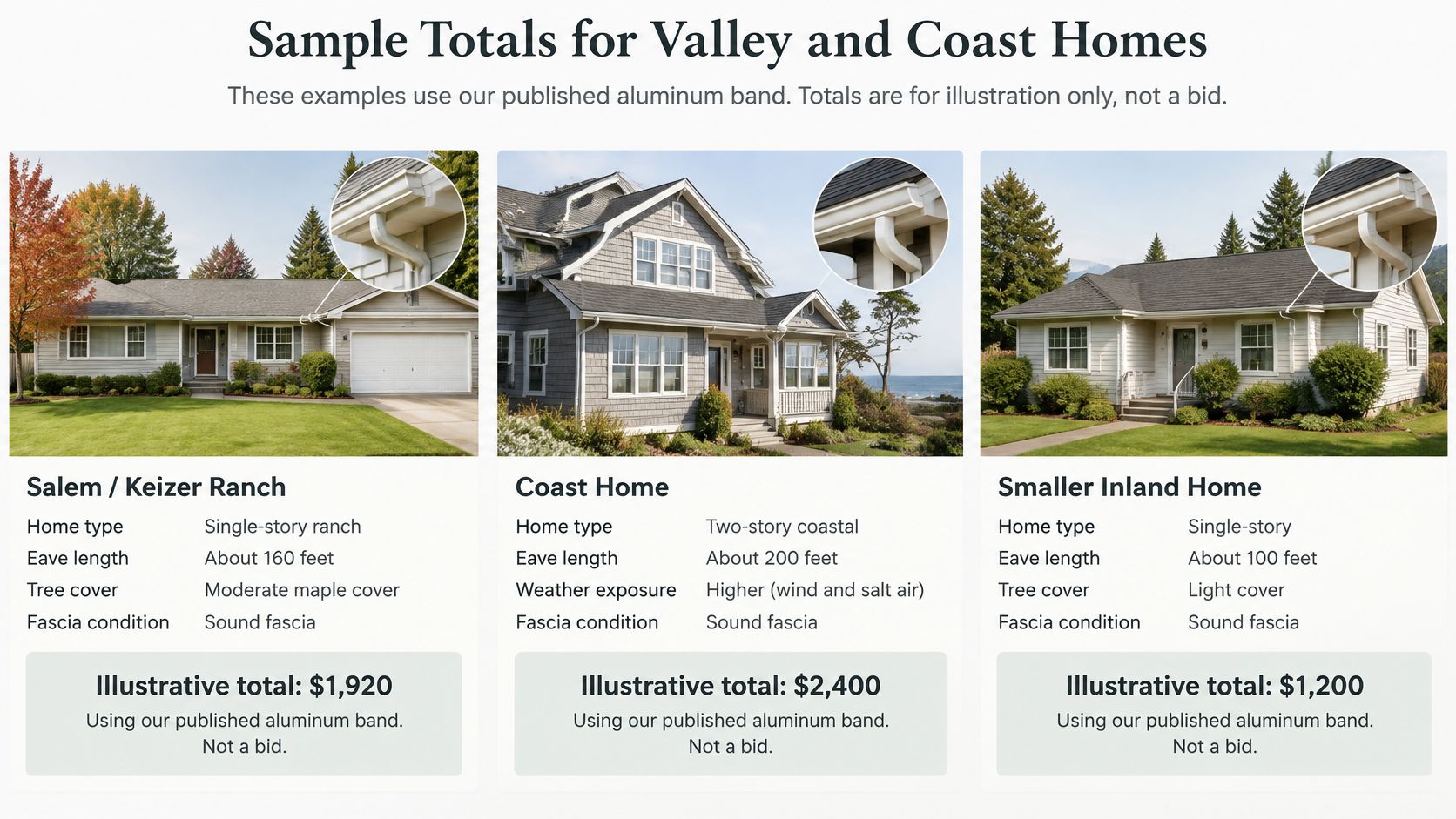
Salem or Keizer ranch. Picture a single story, about 160 feet of eave, moderate maple cover, and fascia that still feels solid when you press it from a ladder at the corner, not from the roof. At $6 to $12 a foot, the gutter run alone illustrates about $960 to $1,920. If the back patio currently dumps at one corner, add a couple of downspouts rather than hoping the slope fixes itself. Ground check: overflowing corners after a steady rain. Stained trim can wait for a dry appointment if water isn't entering the wall.
Portland-area two-story. About 220 feet, several valleys, steep sections, and fir needles in the trough every October. Planning the channel at 6 inch, and allowing a mid illustration of $8 to $15 a foot for the larger profile and harder access, puts the channel near $1,760 to $3,300 before extra downspouts, guards, and any scaffold time. That range is a sketch so you can see how access stacks on footage. It isn't a published average. Ground check: soil washed out under a downspout, or mossy streaks on the fascia. Active overflow into the soffit, a run pulling off the house, or soft fascia should be scheduled. Don't carry that through another wet season.
Lincoln City or Newport cottage. About 140 feet, salt air, Coast Range wind, and fascia that has stayed wet for years. The aluminum channel at $6 to $12 illustrates about $840 to $1,680. The biggest swing is often the wood and the hangers, which can exceed the coil once boards are soft. Ground check: peeling paint at the eave and a gutter that sags between spikes. Small leaks at a joint can wait for a dry day. A run that's leaving the wall cannot.
Late spring through early fall is the easier window for exterior work. Winter is for urgent leaks and storm damage, not for a leisurely color decision. If water is already inside the soffit, call. If you're only seeing light splash and the wood is firm, you can book a measured visit when the forecast breaks.
Preventive Maintenance ROI and Avoided Damage
A budget for continuous gutters covers the whole drainage assembly, not just the channel you see from the sidewalk. HomeAdvisor notes that published estimates can include fasteners, brackets, underlayment, drip edges, and basic flashing, with one cost guide putting those supplies near $3.50 per linear foot on some projects. Scope also changes when old gutters come off, downspouts get rerouted, or roof-edge wood has sat wet for years. Constant rain, moss, algae, fir needles, and coastal salt air expose weak points faster than a dry climate would.

Use your own quotes, not a national average
Don't borrow someone else's repair price. Get two or three written numbers for your house and do the division yourself.
- Get a written price for a yearly cleaning, or for a cleaning paired with moss treatment. Gutter cleaning is offered as a standalone visit or paired with a moss treatment when growth on the roof is feeding the troughs.
- Get a written price for the damage the current system is already causing. Fascia and drip-edge repair is available where water has already gotten in. That might be boards under a valley, or a rebuilt eave. If stains are showing inside, a roof leak repair visit is a separate question from the gutter channel.
- Divide the upgrade by the repair you would avoid. If a correctly sized system costs about what two fascia rebuilds would cost, the payback isn't theoretical.
- Count the cleaning visits the guards would replace, then subtract nothing for "zero maintenance," because there isn't any.
A low per-foot 5-inch system is a false saving when the roof area and the needle load call for a larger profile and more outlets. Overflow is what turns a cheap install into fascia rot and foundation washout. Water sits on rafter tails, feeds moss, stains siding, and cuts a trench in the soil beside the footing.
Guards that shed conifer needles mean fewer ladder trips. They still add material and fitting time, and they still need a look after a heavy drop of debris. After guards go on, downspouts should run to daylight or to drains, and someone should check the system in flow. Compare that package with the cleaning visits it replaces. The return you can see is fewer overflows, less splash at the foundation, and a roof edge that dries between storms.
An itemized estimate should name downspout count and size, outlet locations, guard material if you want it, disposal, and any fascia or eave repair. A single per-foot number can hide all of that.
Get a Measured Written Estimate
A useful gutter quote starts with measurements, not a low per-foot ad. The written scope should list total linear feet, 5-inch or 6-inch profile, aluminum gauge and color, downspout size and count, corner and outlet locations, removal and disposal, guards if selected, and any fascia or drip-edge repair. It should also state the total price and how long the quote remains valid.
The assessment should cover roof area, tree cover, current downspout locations, and fascia condition. From that, the contractor can recommend gutter and downspout sizing and whether guards make sense, then provide a written quote that spells out materials and scope. Damaged fascia needs repair before new gutter is hung, since the hangers need solid wood behind them.
Lock the scope, then check the license
Ask when the price expires and how any material surcharge is calculated. A fixed total for a defined scope makes it easier to compare bids than a vague per-foot special. The estimate should also state who handles permits and inspections if required.
Oregon generally requires contractors doing construction work for pay to hold an Oregon Construction Contractors Board license. The Oregon CCB licensing information explains the licensing requirements. Check the contractor's current status and confirm the license number on the contract matches the state record.
Safeguard Roofing LLC is a family-run roofing contractor serving the Willamette Valley and central Oregon coast. Its gutter assessment includes the roof area, tree cover, downspout locations, and fascia condition, followed by a recommendation and written quote.
For a measured estimate, contact Safeguard Roofing LLC. The written scope should make the system's capacity, repairs, and price clear before work begins.