
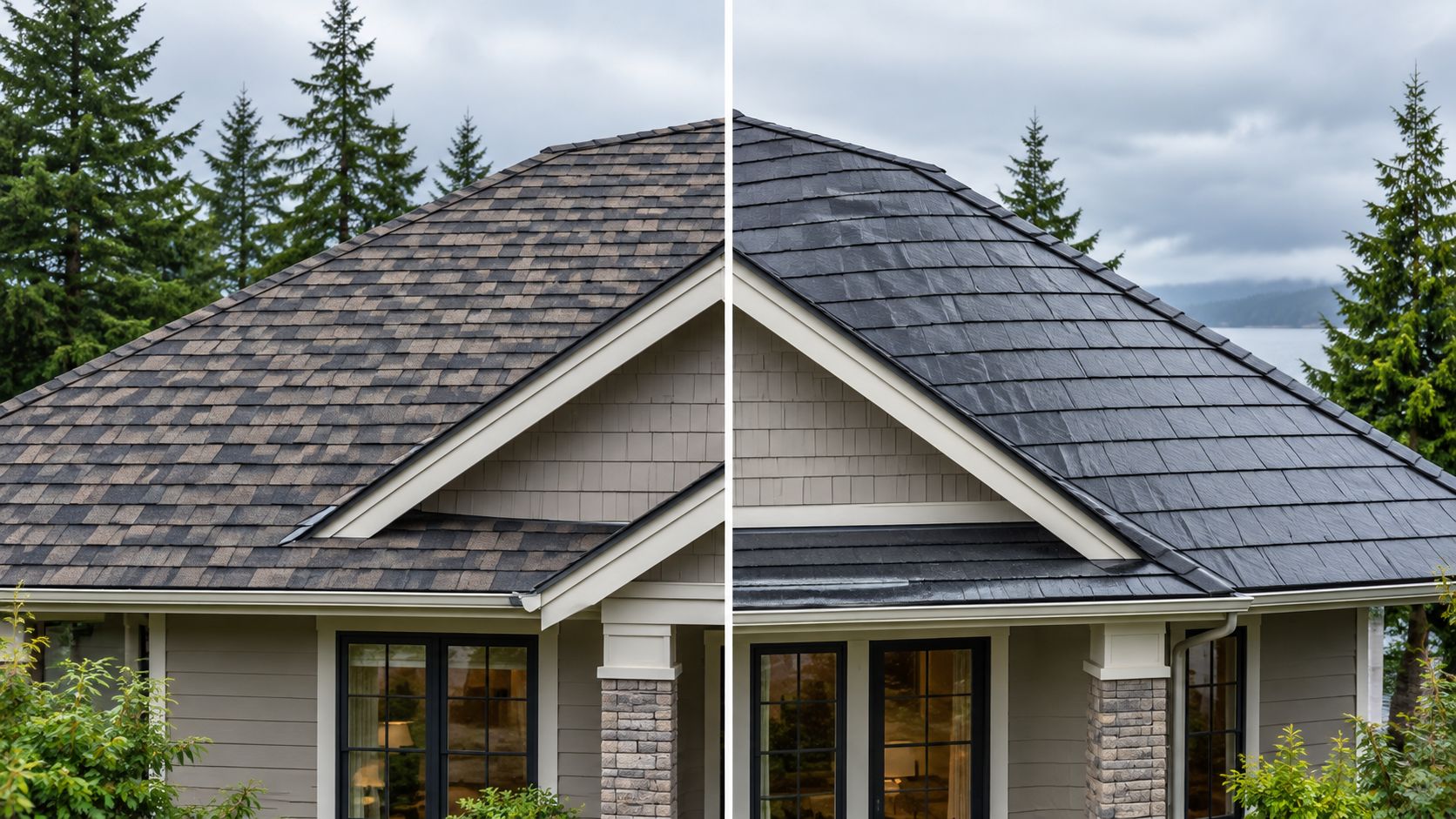
Architectural Shingles vs Composite Shingles for Oregon
The popular advice on architectural shingles vs composite shingles usually goes like this: buy architectural if you're on a budget, buy composite if you want the longer life. That's not wrong, but it's incomplete for a house in Salem, Keizer, Portland, Lincoln City, or Newport. In western Oregon, your roof doesn't fail because you picked the wrong label. It fails because wind-driven rain got under a poorly sealed edge, moss held moisture against the surface for years, ventilation cooked the deck from below, or a low-slope porch got shingles it should never have had.
That's why I'd compare these two options as installed assemblies, not as shingles in a bundle. The shingle matters. So do the starter course, nail pattern, underlayment, flashing, ridge, ventilation, and the maintenance you'll do through long Willamette Valley winters. Once you count tear-off, decking, ventilation, and permits, the price gap also looks different than a simple per-square comparison suggests.
Table of Contents
- Architectural and Composite Shingles Side by Side
- What Each Shingle Is Made Of and How It Looks
- Upfront Cost and Lifespan for a Typical Oregon Roof
- How Each Shingle Holds Up to Oregon Weather
- Wind Ratings and Warranties Read Past the Label
- Recycling and End of Life for Each Option
- Which Shingle Fits Your Roof and When to Call
Architectural and Composite Shingles Side by Side
The shingle label tells you less than the roof assembly does. Architectural shingles are laminated asphalt products; composite shingles are synthetic products molded to resemble slate or wood shake. In a Willamette Valley winter, the practical comparison is how each system handles persistent rain and moisture, what upkeep it needs, and what the full installation costs.
Architectural products are the mainstream asphalt option. A Mordor Intelligence asphalt-shingles market report estimated that architectural or laminated products accounted for 57.8% of global asphalt-shingle market revenue in 2025, in a market valued at approximately $17.51 billion. Composite shingles occupy a smaller, premium category, often chosen for their slate-like or shake-like appearance and longer claimed service life.
| Factor | Architectural asphalt shingles | Composite shingles |
|---|---|---|
| Core material | Asphalt-coated fiberglass mat with bonded laminated layers | Engineered polymers or recycled synthetic materials |
| Appearance | Dimensional look with shadow lines | Imitates slate or wood shake; check the specific product sample |
| Installed cost, 2,000 sq ft roof | $7,000 to $14,000 before extras | $16,000 to $32,000 before extras |
| Typical field life | 25 to 30 years under good conditions | 40 to 50 years with sound installation and maintenance |
| Weight | Lighter than natural slate | Lighter than natural slate; confirm pounds per square on the rating sheet |
| Wind rating disclosure | Products commonly publish 110 mph standard and 130 mph enhanced wind warranties when specified accessories are used; confirm the tested ASTM classification for the named product | Request the tested standard and wind class in writing for the named product |
| Warranty | Limited lifetime; the non-prorated portion often lasts 10 to 15 years | Get the term, proration schedule, and exclusions in writing before signing |
| Repair | Single-shingle replacement is familiar to most crews | Confirm matching pieces and the manufacturer-approved repair method |
| End of life | Recycling routes exist, but are local and limited | Ask the manufacturer for a documented recovery or disposal path |
How to read a table cell that points you to paperwork
A rating sheet or warranty document matters because products within the same category can differ in materials, thickness, fastening systems, and coverage. Architectural shingles are a more standardized category, but wind warranties and warranty periods still vary by product and installation details.
Practical rule: If an estimate says only “architectural” or “composite,” ask for the product name, spec sheet, and warranty document before comparing bids.
The price gap in the table is only a starting point. Tear-off, decking repairs, ventilation work, and permits can change the total for either roof, so compare complete estimates rather than shingle prices alone. For a wet Oregon roof, weigh that installed cost against the product's expected life and the maintenance the manufacturer requires.
What Each Shingle Is Made Of and How It Looks
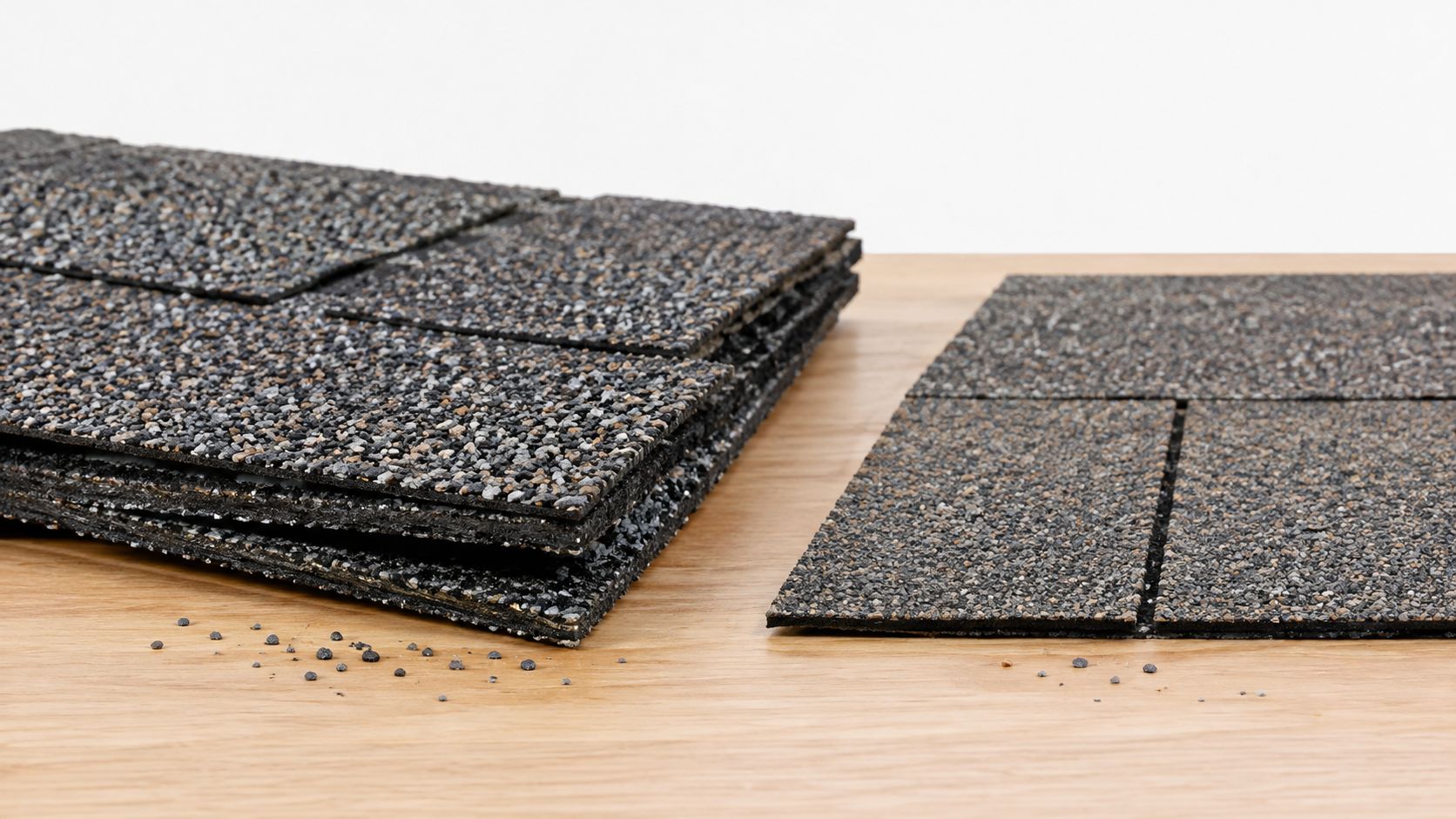
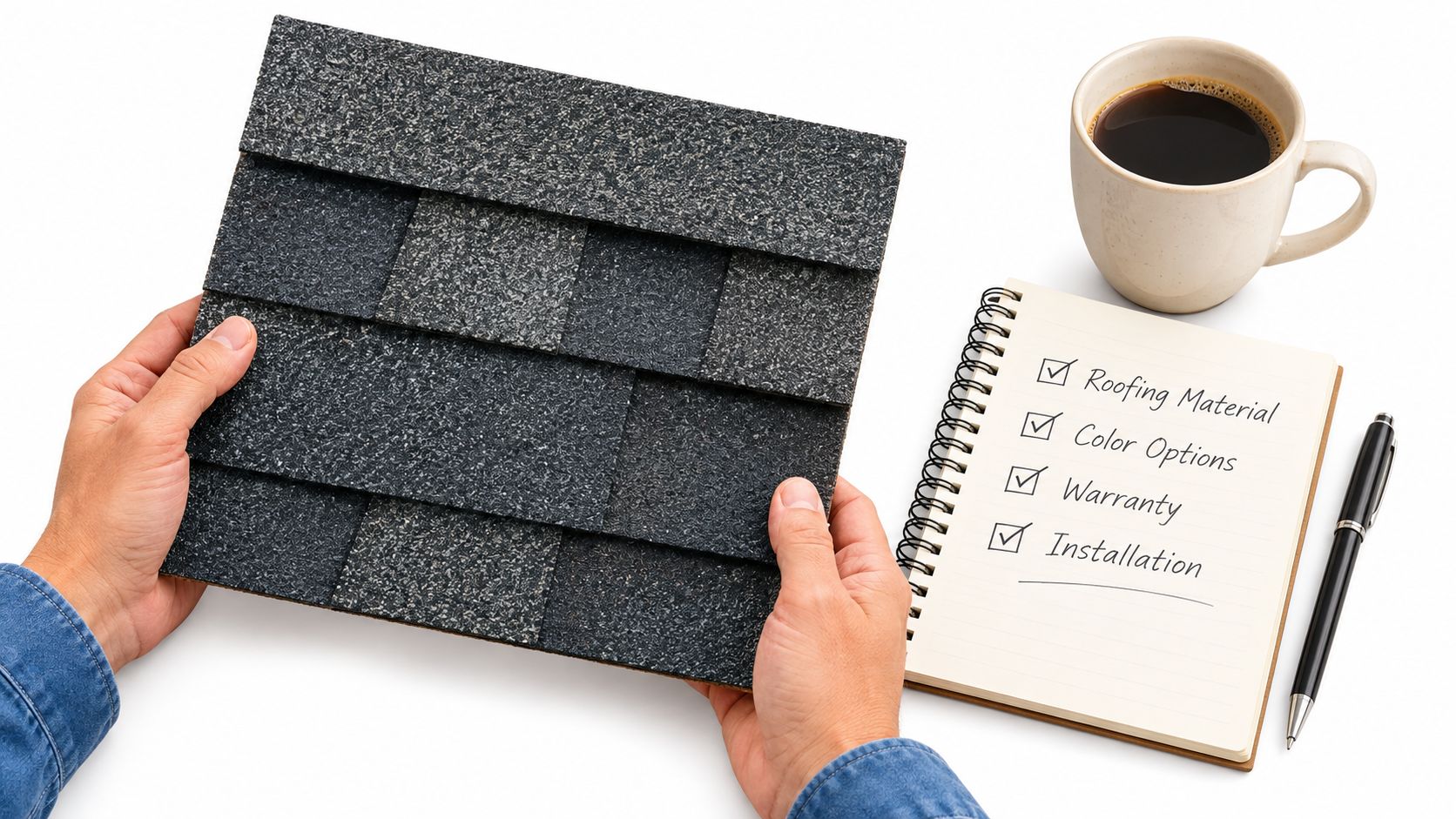
An architectural shingle starts as a fiberglass mat coated in asphalt and topped with mineral granules. The difference from an old three-tab is lamination. Two or more layers are bonded into one tab, so the finished shingle is thicker and stiffer, and the offset layers create the shadow lines you see from the street.
That layering isn't just cosmetic. Extra thickness over the nail zone and a stronger body give the seal strip and fasteners more to work with when wind tries to lift a tab. For a closer look at how these systems are put together for local homes, see the details on asphalt shingle roofing installation and compare that assembly language to what's in your own estimate.
The photo below shows the physical difference your hands notice before your eyes do.
What composite actually means
Composite shingles are molded from engineered polymers or recycled synthetic materials to copy slate, wood shake, or other premium profiles. They're usually far lighter than quarried slate, which is the main reason homeowners consider them for a slate look on a standard framed roof. Textures range from fairly flat slate tiles to deep shake profiles with heavy shadow.
The naming problem is real. Composite is used loosely in the trade, and in some contexts people even use it to describe asphalt composition shingles. A product sold as composite may differ widely in formulation, thickness, fire classification, and warranty from the next one. The label tells you almost nothing you can bank on.
So do a simple check before anyone orders material:
- Get the exact product name: Ask for the manufacturer, line, and color in the written estimate.
- Ask for the spec sheet: Look for the tested standard, minimum slope, fastening pattern, and fire class.
- Handle a sample: Hold it next to an architectural shingle at the supplier and compare thickness, flex, and edge profile.
- Check the accessories: Confirm starter, ridge, and hip pieces exist for that line and are included in the bid.
How each reads from the street in Oregon
On a typical Salem or Portland street, architectural shingles are the familiar look: staggered, dimensional, and forgiving of small alignment imperfections. Composite slate reads flatter and more formal. Composite shake reads chunkier, with deeper grooves.
Those grooves matter here. Moss and algae streaking show up first on north-facing slopes and under firs, and they collect in texture. A color that looks clean in a showroom can look patchy after a few wet seasons if one slope stays shaded. Pick the color with that in mind, and plan on cleaning either roof. Neither material is maintenance-free under Oregon tree cover.
Upfront Cost and Lifespan for a Typical Oregon Roof
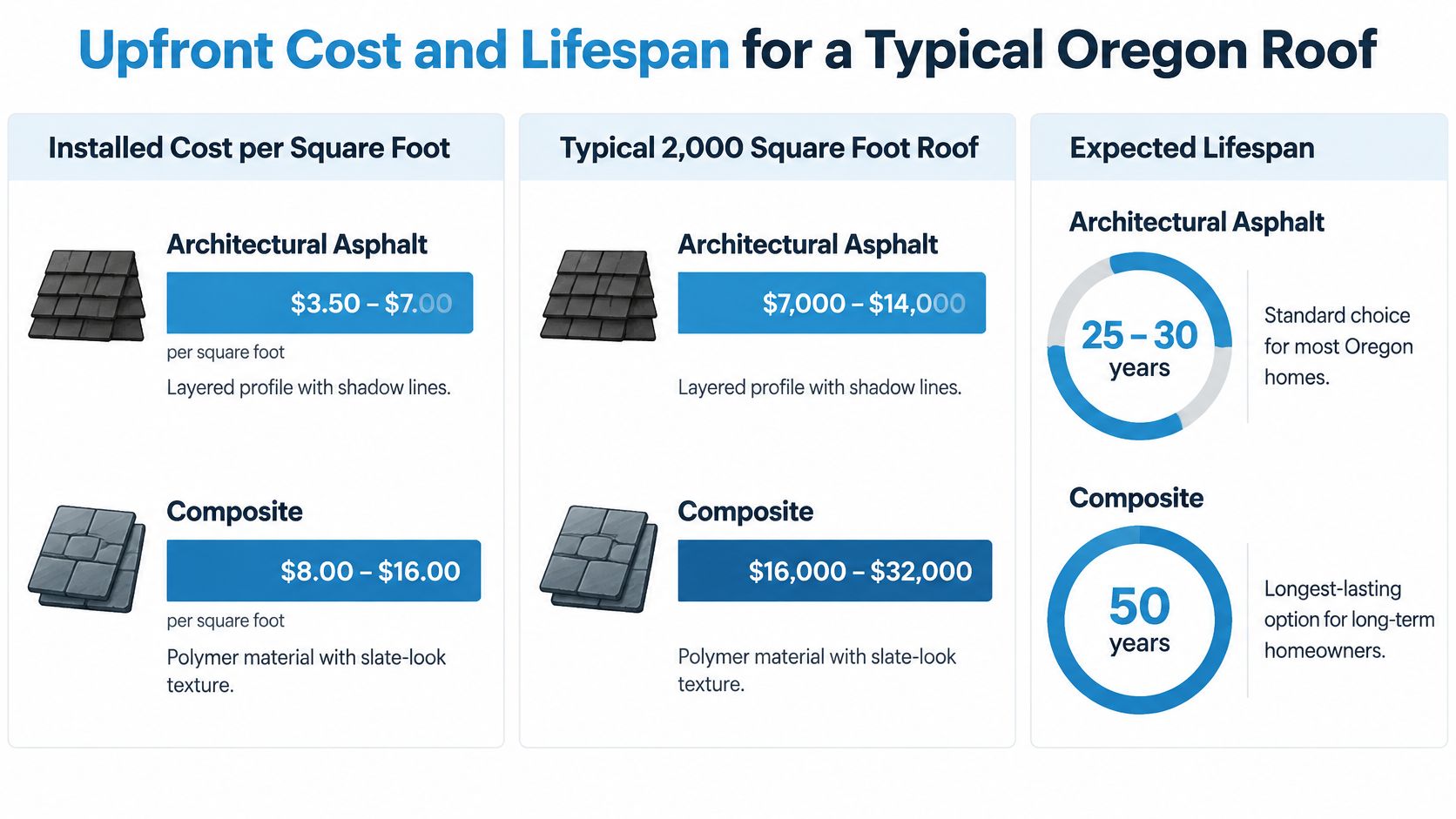
The price gap is the honest center of architectural shingles vs composite shingles. The 2026 comparison from The Roofing Brief reported installed costs of approximately $3.50 to $7.00 per square foot for asphalt composition shingles, compared with about $8.00 to $16.00 per square foot for synthetic composite shingles. On a 2,000 square foot roof surface, that's roughly $7,000 to $14,000 for asphalt composition roofing and $16,000 to $32,000 for composite roofing, before project-specific complications such as tear-off, deck repairs, ventilation work, flashing, permits, and disposal.
The same comparison estimated typical field life at 15 to 30 years for asphalt products and 40 to 50 years for composite products, with architectural asphalt at the upper end at approximately 25 to 30 years under good conditions, compared with 15 to 20 years for conventional three-tab shingles. If you're weighing how long a roof will realistically last locally, the breakdown of roof life in Oregon conditions is worth reading alongside any bid.
This chart puts the cost and lifespan ranges next to each other.
The rough cost per year check
Divide the midpoints and you get a useful gut check. An asphalt midpoint of $10,500 over about 27.5 years works out to roughly $380 per year of service. A composite midpoint of $24,000 over about 45 years works out to roughly $530 per year.
That's a rough calculation. It ignores extras, warranty terms, financing, and the fact that a roof replaced early for moss damage or bad ventilation never reaches its nominal life. It does correct one common assumption: the longer-life roof isn't automatically the cheaper roof per year. Composite can still make sense for a long-term home or a slate look, but it usually doesn't win on simple annualized cost.
| Measure | Architectural asphalt | Composite |
|---|---|---|
| Installed cost per square foot | $3.50 to $7.00 | $8.00 to $16.00 |
| Installed cost, 2,000 sq ft roof | $7,000 to $14,000 | $16,000 to $32,000 |
| Typical field life | 25 to 30 years in good conditions | 40 to 50 years |
| Rough cost per year of service, midpoints | About $380 per year | About $530 per year |
| Extras that can change the total | Tear-off, deck repair, ventilation, flashing, permits, disposal | Same list, plus product-specific install requirements |
A worked example with the extras counted
Say you have a roof of about 1,800 square feet in Keizer with one layer to remove and several sheets of soft decking at the eaves. The shingle choice sets the base price, but tear-off labor, disposal, new decking sheets, drip edge, flashing at the chimney, and added intake ventilation land on both bids. Those lines can add thousands before a single new shingle goes down, and they shrink the percentage gap between the two materials even though the dollar gap stays large.
The short video below walks through how those scope items build a real replacement price.
A longer nominal life only pays if the roof reaches it. Moss left to thicken, poor attic ventilation, and sloppy wet-season detailing shorten both materials. Ask every bidder to itemize tear-off layers, decking at a per-sheet price, underlayment type, ventilation changes, flashing, permits, and disposal so you can compare two bids line by line.
How Each Shingle Holds Up to Oregon Weather
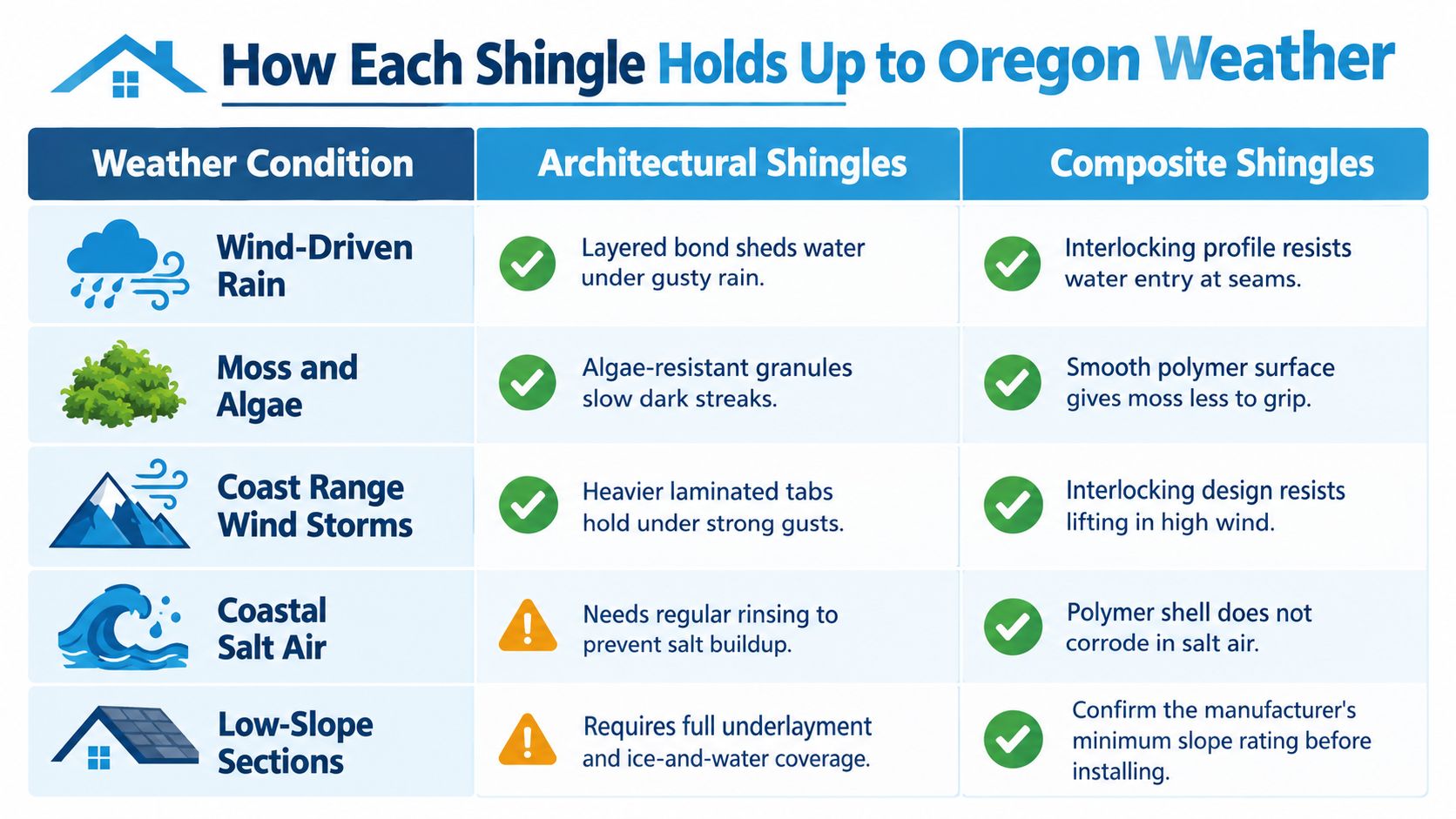
Western Oregon doesn't test a roof one way. It tests it five ways at once, for months. The chart below summarizes how each material typically meets those conditions.
| Oregon condition | Architectural asphalt | Composite | What to confirm |
|---|---|---|---|
| Wind-driven rain | Rely on the sealing strip bond and correct nailing pattern | Rely on the product profile and its specified fastening method | Starter course and nail pattern in the estimate |
| Moss and algae | Growth holds moisture against the surface and granules | Growth holds moisture on textured surfaces, confirm stain resistance for the named product | Zinc strips and a cleaning schedule |
| Coast Range wind storms | Rated classes apply only to the tested assembly | Request the tested wind classification for the named product | Wind classification for exposed ridges and edges |
| Coastal salt air | Fasteners and flashing metal matter as much as the shingle | The same metal details apply around the synthetic surface | Corrosion-resistant fasteners and flashing |
| Low-slope sections | Needs at least 2:12 pitch under Oregon residential code | Confirm the manufacturer's stated minimum pitch in writing | Membrane roofing such as TPO for lower pitches |
Where the assembly beats the category
In driving rain, the sealing strip bond, nail placement, and starter course usually matter more than whether the shingle is asphalt or synthetic. Water pushed sideways by a Coast Range storm finds unsealed tabs and exposed fasteners, not brand names. If your home takes gusts across an open field or off the water in Newport, treat edges, hips, and ridges as the weak points and ask how each will be detailed. After a storm, that same logic guides storm and wind damage repair: fix the assembly detail that failed, not just the missing piece.
Moss and algae don't care what your shingle is made of. They hold moisture against any surface, lift edges as they thicken, and keep the roof wet longer after rain. Zinc strips near the ridge and a regular gentle cleaning schedule matter for both types. Skipping that upkeep is the fastest way to make a premium roof age like a budget one.
Slope is a hard limit, not a preference. The Oregon residential code roof assembly provisions limit asphalt shingles to roof slopes of at least 2 units vertical for every 12 units horizontal, a 2:12 pitch, and for slopes from 2:12 through 4:12, two layers of underlayment are specified. Porch roofs and additions below that pitch usually need membrane roofing such as TPO instead of either shingle.
Warning signs you can check from the ground
You don't need to climb anything to spot trouble early. Use binoculars or phone photos from the yard.
- Dark streaks or thick moss: Especially on north slopes and under overhanging firs.
- Granules in the gutters: A handful after a storm is normal on a new roof, steady buildup on an older roof signals wear.
- Lifted or curled tabs: Visible from the street as shadows or uneven lines along a course.
- Cracked or missing ridge caps: The ridge takes wind from both sides and fails early.
- Sagging or standing water: Most concerning on low-slope sections after rain ends.
- Ceiling stains near vents or chimneys: Often a flashing problem, not a field shingle problem.
Safety note: Never walk on your roof to check any of this. Wet shingles and moss are slick, and a fall costs more than an inspection.
If you see two or more of those signs together, schedule a professional inspection rather than waiting for an active drip. One cosmetic streak can wait for a planned cleaning. A lifted ridge plus granules plus a ceiling stain shouldn't.
Wind Ratings and Warranties Read Past the Label
A wind rating applies to a tested roof assembly, not to a shingle by itself. For an Oregon roof, compare the required installation details and warranty terms alongside the number on the package.
ASTM D3462 covers fiberglass-mat asphalt shingles. ASTM D3161 evaluates fan-induced wind resistance, ASTM D7158 evaluates wind resistance under uplift, and ASTM E108 and UL 790 address fire exposure. These standards measure different properties, so a fire classification does not tell you how well a roof will resist wind.
Why this matters on the coast and in the valley
On an exposed roof in Lincoln City or outside Salem, a missed starter strip or incorrectly placed fasteners can disqualify a roof from an enhanced wind warranty. The shingle may be intact, but the assembly does not meet the warranty's installation conditions. Ask your contractor to specify the nail pattern, starter strip, ridge product, slope and underlayment in the estimate.
Architectural shingles often carry limited lifetime product warranties, but “lifetime” does not mean every repair is covered for the roof's full service life. Read the terms for the non-prorated period, how coverage changes afterward, exclusions for wind damage, and installation requirements. The practical worth depends on what the warranty covers and whether the roof was installed to qualify.
What to demand for a composite product
Composite products do not share one testing or warranty standard across brands. Get these details for the exact product in your bid:
- The tested standard: Which wind and fire classifications apply.
- The required assembly: Starter, underlayment, fastening schedule and minimum slope.
- The warranty document: Coverage term, non-prorated period, proration schedule and transfer rules.
- The completion paperwork: Warranty registration and product documentation.
If a bidder cannot provide those details, do not compare that product's wind figure with an architectural shingle's rating. Compare documented test results and installation requirements instead, then weigh any price difference against the work needed to build the warranted assembly.
Recycling and End of Life for Each Option
A conventional architectural shingle with a local recycling outlet can have a clearer end-of-life path than a premium composite with no recovery plan. The label “composite” alone says little about what happens when the roof is torn off.
Asphalt shingles can be recycled into paving and other products, but access depends on location. The Asphalt Roofing Manufacturers Association's shingle recycling summary cites research estimating that less than 5% of asphalt shingles are currently recycled. For a roof near Salem, Portland, or the coast, ask whether a nearby facility accepts your tear-off and whether hauling it there changes the bid.
Composite products can contain polymers, rubber, fiberglass, and reclaimed materials. Recycled content may reduce the need for virgin material and manufacturing energy, but confirm the benefit in documentation for the specific product rather than relying on the category label.
Before choosing, ask:
- Verified recycled content: Does the manufacturer publish a figure for this product, and who verified it?
- Local acceptance: Will a nearby recycler accept the tear-off, and what will hauling add to the bid?
- End-of-life plan: Does the manufacturer offer take-back or document a disposal route?
- Replacement frequency: A roof replaced half as often produces half as much tear-off over the time you own the home.
In a wet Willamette Valley winter, upkeep also affects the environmental trade-off. Moss treatments, cleaning chemicals, and replacement frequency all matter. A composite that reaches its stated service life may mean fewer tear-offs; without product documentation or a local disposal route, its higher price may still end with a trip to the landfill.
Which Shingle Fits Your Roof and When to Call
The shingle label matters less than the full roof assembly and how it will hold up through a Willamette Valley winter. Start with the roof's slope, exposure, budget, and how long you expect to stay. The table offers a starting point, not a substitute for comparing the specific products and installation details.
| Roof situation | Lean toward | Why |
|---|---|---|
| Budget-driven replacement, may sell within 10 years | Architectural asphalt | Lower installed cost and familiar repairs |
| Staying 25 or more years and want longer life | Composite, if the product and warranty are documented | Longer field life can offset higher upfront cost |
| Slate-like look with weight limits | Composite | Lighter than natural slate while imitating its look |
| Complex roof with exposed hips and ridges on the coast | Architectural with enhanced wind installation, or composite with a verified rating | Wind performance depends on the tested assembly, not the label |
| Low-slope addition or porch | Neither, membrane roofing | Asphalt shingles need at least a 2:12 pitch |
Steps to take before you sign anything
Verify any contractor's Oregon CCB license through the state license search before signing, including ours. A license does not guarantee workmanship, so also ask how the crew will inspect the deck after tear-off and price any rotten sheets. Settling that detail before work starts helps avoid confusion once the roof is open.
Confirm which permits your city or county requires for a tear-off and replacement, and who will obtain them. Requirements differ between Salem, Keizer, Portland metro cities, and coastal communities. The contract should name the permit holder, and the estimate should show permit costs as a separate line.
Plan around the weather. Late spring through early fall generally offers more dry stretches for tear-off and dry-in; winter work needs tighter weather windows and more contingency. If the roof can safely wait, booking ahead may help you avoid an emergency replacement during January rain.
When to call now and when it can wait
Call a professional promptly for an active leak, a soft or sagging area visible from the ground, or shingles lifted by a storm. Water can reach the decking and framing, and prolonged wetting can increase the repair scope. A missing ridge section on a coastal home also needs attention before storm season.
Light algae streaking can usually wait for a planned inspection and cleaning. Thick moss that lifts shingle edges deserves attention before another full wet season passes.
Whichever material you choose, ask for a written, itemized estimate that names the exact product, underlayment, ventilation scope, flashing work, tear-off layers, decking price per sheet, permits, and disposal. Comparing those line items shows whether the price gap reflects the shingle alone or also the work needed to make the roof assembly perform.
If you're weighing architectural against composite for a home in the Willamette Valley, the Portland metro, or on the central coast, Safeguard Roofing LLC can inspect your current roof, check the deck and ventilation, and provide a written, itemized estimate for both assemblies. Call 971-518-0028 or request an estimate through safeguardroofing-or.com/contact to discuss the numbers line by line.